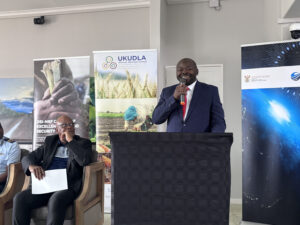
CoE-FS principal investigator and UKUDLA project co-lead A/Prof Clement Nyirenda participated as a panellist in the discussion about science, education and human rights. Photo Carla Bernardo/CoE-FS and UKUDLA.
At a recent Human Rights Day commemoration, the DSTI-NRF Centre of Excellence in Food Security (CoE-FS) and the African German Centre for Sustainable and Resilient Food Systems and Applied Agricultural and Food Data Science (UKUDLA) participated in a flagship science engagement event at Norham Farm in Grabouw, Western Cape.
Hosted by the National Research Foundation’s South African Agency for Science and Technology Advancement (NRF-SAASTA) Public Engagement Platforms team, in partnership with Kaapschön Boerdery, the event took place at a site being transformed into a science centre for children from surrounding rural farming communities. Researchers, government representatives, educators, community members and scores of children gathered around a shared message that shaped the day: science is a human right.
The Grabouw engagement formed part of an early Human Rights Day commemoration and aimed to create sustained public engagement with science. CoE-FS and UKUDLA hosted two adjacent exhibition stands, and CoE-FS principal investigator and UKUDLA project co-lead Associate Professor Clement Nyirenda participated as a panellist in the discussion. His contribution placed mentorship, exposure and the future of young people at the centre of conversations about science, education and human rights.
The location of the event was intentionally chosen: Norham Farm, home to Kaapschön Boerdery led by community developer Aldrin October, is situated in the Elgin and Grabouw valley near the South African National Space Agency satellite operations. In opening the programme, October emphasised the importance of ensuring that local communities benefit from and have access to high-level scientific developments in their region.
The programme included an opening welcome by October, a keynote address by prominent social scientist Professor Amanda Gouws and a high-level multi-sector panel discussion facilitated by SANSA’s Thandile Vuntu. The panel brought together senior representatives from academia, government, defence, space science and industry, including Denel CEO Tsepo Monaheng; Major General Lancelot Mathebula of the South African Air Force; Sam Zungu, Deputy Director-General at the Department of Higher Education and Training; and Associate Professor Nyirenda.
Nyirenda’s contribution focused on the transformative power of exposure to science and the responsibility of researchers and universities to engage with young people early. Drawing on his experiences in higher education and mentorship, he highlighted how visibility and encouragement can change the trajectory of young lives.
“Exposure is super important,” he told the audience. “When children see what is possible, it stays with them. What the eye sees, the heart never forgets.”
His message resonated strongly in a room filled with children from surrounding farming communities. Nyirenda emphasised that young people develop skills in different ways and that recognising individual strengths early on can help learners discover pathways that may otherwise remain hidden. He also highlighted the rapid evolution of fields such as Artificial Intelligence (AI) and data science, stressing the responsibility of universities to keep pace with change.
“We have to introduce what is new and what is trending in what we teach, because we are preparing these students for what is out there,” he said, emphasising the need for curricula that evolve alongside fast-moving scientific and technological developments.
For CoE-FS and UKUDLA, the exhibition stands complemented this message by creating space for direct engagement with learners throughout the day. Staff and students spoke with visitors about the diverse disciplines that contribute to food security, including environmental science, agriculture, AI, geospatial science and data science.
During the programme, Lebogang Moropane, an UKUDLA doctoral candidate from a similar village, shared her own journey into geospatial science, echoing Nyirenda’s emphasis on exposure and mentorship, and the importance of girls having access to science.
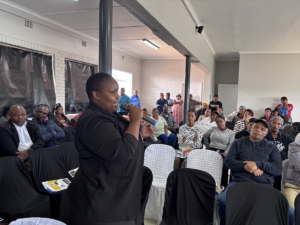
UKUDLA PhD candidate Lebogang Moropane shared her journey into geospatial science. Photo Carla Bernardo/CoE-FS and UKUDLA.
“I did not know that a field like geospatial science existed,” she explained. “Now I am obsessed with it. It has changed my life because I am at peace and happy doing what I love.”
Her story reinforced the broader message of the day. By sharing personal journeys into science, researchers and students helped learners imagine new possibilities for themselves. The collaboration between NRF-SAASTA, Kaapschön Boerdery, CoE-FS and UKUDLA reflects a shared commitment to making science accessible beyond traditional academic spaces.
For the CoE-FS and UKUDLA, public engagement remains central to its mission of advancing equitable and sustainable food systems. Events like this demonstrate the importance of connecting research to communities and ensuring that knowledge is accessible to all. Most importantly, the day underscored the role of young people in shaping the future of science.


related Articles
From burden to solutions: World Food Safety Day highlights importance of food...
The World Food Safety Day event was co-hosted by the University of Pretoria’s (UP) Department of Residence Affairs and Accommodation…
Advancing food security through global partnerships: CoE-FS, UKUDLA hosts German Federal Minister...
Minister Alois Rainer, head of Germany’s Federal Ministry of Agriculture, Food and Regional Identity, undertook a high-level courtesy and working…
CALL FOR APPLICATIONS: Postdoctoral Research Fellowship 2026
Photo by Markus Winkler/Pexels. The DSTI–NRF Centre of Excellence in Food Security (CoE-FS), hosted by the University of the Western…