Time: 12h00 - 14h00 SAST
Venue: Zoom
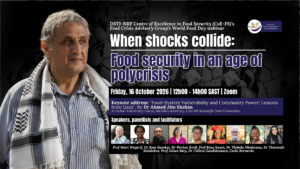
The DSTI-NRF Centre of Excellence in Food Security (CoE-FS) will mark World Food Day on Friday, 16 October 2026, with a webinar examining how interconnected crises are affecting food and nutrition security in South and Southern Africa.
Titled “When shocks collide: Food security in an age of polycrisis”, the webinar will also introduce the CoE-FS’s newly established Food Crisis Advisory Group, a multidisciplinary research collective focused on generating and mobilising evidence to inform preparedness, response and mitigation of food-related crises.
Food crises rarely have a single cause. Across Southern Africa, climate extremes, biodiversity loss, rising fuel and food prices, economic inequality, water and energy insecurity, geopolitical instability and disruptions to trade and supply chains are placing food systems under increasing pressure.
These challenges interact, intensifying existing vulnerabilities and threatening agricultural production, livelihoods, food affordability, nutrition and food safety.
Using El Niño as an immediate case study, the webinar will consider how climate-related shocks can compound these pressures, what previous crises have taught us, and how research can contribute to more coordinated, anticipatory and effective responses.
Lessons from Gaza: Food-system vulnerability and community power
The webinar will feature a keynote address by Dr Ahmed Abu Shaban, Dean of the Faculty of Agriculture and Veterinary Medicine at Al-Azhar University–Gaza, Visiting Professor in the Department of Natural Resource Sciences at McGill University, Canada, and member of the CoE-FS Scientific Sub-Committee (SCICOM).
Titled, ‘Food-System Vulnerability and Community Power: Lessons from Gaza’, his address will draw on research on food systems and climate vulnerability in Palestine, and examine how control over land, water, infrastructure, and agricultural inputs weakens food-system autonomy and constrains adaptation to climate change.
Dr Abu Shaban will trace how these conditions escalated during the genocide in Gaza into the systematic destruction of the means to produce, distribute, and access food. The keynote will also explore how decentralised production, women-led networks, Indigenous knowledge, and mutual assistance sustain elements of food provisioning, while highlighting their limits under restricted resource access.
These experiences will provide a starting point for examining how climate pressures interact with conflict, rising food and fuel prices, and supply disruptions, and for considering how El Niño could compound existing vulnerabilities in Southern Africa. The address emphasises food sovereignty and community decision-making as foundations for lasting resilience.
Bringing multidisciplinary research to bear on food crises
The keynote will be followed by a multidisciplinary panel discussion examining food-system risks and responses through three interconnected areas of research:
- Governance, power and policymaking: Who governs crisis preparedness and response, whose interests shape decisions, and who bears the greatest risks?
- Innovation, technology and climate resilience: How can agricultural production and food systems become more adaptive and resilient to climate-related and other disruptions?
- Nutrition and food safety: How do crises affect food affordability, dietary quality, nutrition and the safety of food consumed by households?
The discussion will feature researchers and experts from the CoE-FS and partner institutions, including Professor Marc Wegerif, Dr Florian Kroll, Dr Thobela Nkukwana, Dr Rose C. Ramkat, Professor Rina Swart and Dr Tintswalo Molelekoa.
CoE-FS Director Professor Julian May will also participate in the programme. Dr Colleta Gandidzanwa will facilitate the webinar, with CoE-FS Communication and Engagement Manager Carla Bernardo moderating the panel discussion.
The event will introduce the Food Crisis Advisory Group, bringing together research expertise to better understand emerging and ongoing food-related crises, strengthen the evidence available to decision-makers, and support more proactive approaches to food-system risk.
Event details
Date: Friday, 16 October 2026
Time: 12h00–14h00 South African Standard Time (SAST)
Platform: Zoom
Attendance: Online, with registration required
Register for the webinar here.
The webinar is open to researchers, policymakers, government representatives, civil society organisations, agricultural and food-sector practitioners, students and members of the public interested in food and nutrition security, climate resilience and crisis preparedness.


Upcoming Events
World Food Day: When shocks collide – Food security in an age...
Time: 12h00 - 14h00 SAST
Venue: Zoom
Our GOALS
We recognise that producers, processors, distributors and consumers are incorporated into the food system under varying terms and returns. We also recognise the economic, social, human and environmental health impacts associated with food security. Therefore our goal is to conduct research, build capacity and disseminate findings that will promote a sustainable food system in South Africa.
Our MISSION
Our research is concerned with the scale, nature, causes and consequences of food insecurity in South Africa and elsewhere on the African continent. Thus our mission is to investigate products, technologies, processes and policies that can reduce food insecurity and mitigate its negative outcomes. We seek to make a difference to food security by linking innovative science with critical enquiry.