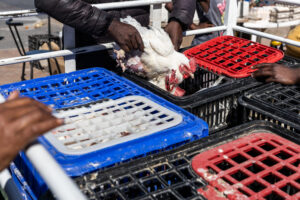
For her master’s research, Nolutando Didiza looked at two case studies in the Breede River Municipality: a bioenergy plant that converts food waste into energy, and a local agricultural practice where farmers raise spent layer chickens for meat. Photo Ashraf Hendricks/CoE-FS.
Food security is often framed in terms of production: how to grow more, distribute better, and feed more people. But what if one of the most powerful solutions lies not in producing more, but in wasting less?
As the world marks International Day for Zero Waste, new research from the DSTI-NRF Centre of Excellence in Food Security (CoE-FS) highlights how food system waste can be reimagined as a valuable resource, with implications for sustainability, economic development, and resilience. Drawing on case studies from the Breede Valley Municipality (BVM), Nolutando Didiza’s master’s research offers a look at how circular economy principles are emerging, and how collaboration between various actors — including communities, local governments and industry — can help turn what’s widely regarded as a problem, into an opportunity.
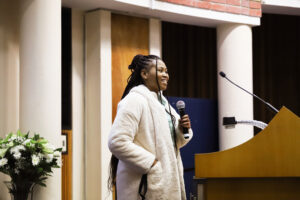
Nolutando Didiza presents her initial findings at the CoE-FS 10-year Anniversary Research Symposium in 2024. Photo Je’nine May/CoE-FS.
Waste as a resource
In her research, Didiza, who is completing her Master’s in Development Studies at CoE-FS host institution, the University of the Western Cape (UWC), focuses on how waste from food systems can be repurposed into useful outputs rather than being discarded.
“My research looks at how waste from food systems can be turned into something useful, such as energy, fertiliser, or food products, instead of being thrown away,” she explained.
Her work centres on two case studies in the BVM: a bioenergy plant that converts food waste into energy, and a local agricultural practice where farmers raise spent layer chickens for meat. These examples illustrate how different parts of the food system can be reconnected through circular processes.
“The research explores how different stakeholders, such as government, businesses, and communities, work together to create a more circular economy, where waste becomes a resource rather than a problem.”
This framing shifts waste from being an issue to an opportunity. It also aligns with growing global recognition that reducing food loss and waste is essential to achieving sustainable food systems.
Social dimensions of waste
One of the study’s most significant findings is that waste management challenges are not purely technical. While technologies to convert waste into energy or other products already exist, their success depends heavily on human systems: relationships, coordination, and governance.
“One of the most interesting findings is that waste is not just a technical issue, but also a social one,” Didiza noted.
“Even when technology exists to turn waste into energy or other useful products, progress depends on collaboration between stakeholders.”
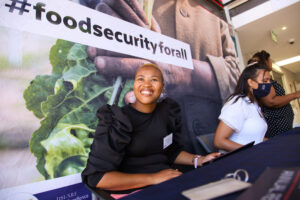
Nolutando Didiza at the local launch of the “2023 Lancet Series on Breastfeeding”, hosted at UWC by the CoE-FS and the DSTI-NRF Centre of Excellence in Human Development. Photo Je’nine May/CoE-FS.
Her research found that this collaboration is often uneven.
“I found that cooperation is sometimes limited, meaning opportunities for innovation are not always fully realised.”
At the same time, the study highlights an important counterpoint: circular practices are already happening in communities.
“I found that communities are already practising forms of circular economy in everyday life, such as reusing agricultural by-products.”
“These grassroots practices show that solutions already exist, but need better support, policy alignment, and investment to grow.”
This dual insight — that both barriers and solutions are social — underscores the need for more inclusive, coordinated approaches to waste management.
Stakeholders and systems
A key strength of the research lies in its engagement with a wide range of stakeholders. These include local government officials, private sector actors, farmers, and community members in the BVM.
Through interviews, the study captures how each group understands waste, sustainability, and innovation, as well as the constraints they face. Stakeholders shared their experiences, challenges, and ideas for improving waste management systems.
“Their perspectives helped identify both barriers and opportunities for developing more inclusive and effective circular economy solutions,” said Didiza.
This multi-actor perspective is critical. Waste systems are inherently interconnected, and interventions that do not account for these relationships risk reinforcing existing inefficiencies or exclusions.
Why waste matters for food security
Didiza’s research makes a compelling case for why waste must be central to food security discussions.
“Food security is not only about producing more food, but also about reducing the amount of food that is lost or wasted,” she said.
“When food waste is reduced or reused, more resources become available to support communities.”
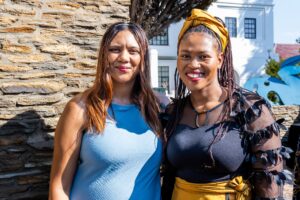
In addition to being a CoE-FS grantee, Nolutando Didiza (right) provides part-time administrative assistance to the Centre, and is CoE-FS Director Professor Julian May’s research assistant. Pictured here with CoE-FS Administrative Assistant Robyn Engelbrecht at the launch of CoE-FS documentary, “Harvesting a Valley of Resilience: Challenges and Solutions from the Western Cape”. Photo Riaan West/CoE-FS.
The implications are both environmental and socioeconomic.
“For example, agricultural by-products can be used for energy production, fertiliser, or alternative food sources. This helps improve the efficiency of food systems and supports more sustainable and resilient communities.”
By reframing waste as part of the food system rather than outside it, the research highlights opportunities to reduce pressure on natural resources, lower greenhouse gas emissions, and create new forms of value.
“This research is important because it shows how waste can become a valuable resource that supports sustainable development, job creation, and environmental protection.”
It also offers practical insights for policy and planning.
“By understanding how stakeholders interact and how technologies are adopted, the study provides practical insights that can help municipalities and policymakers design more inclusive waste management systems.”
From research to action
As Didiza’s research enters its final stages, the focus is shifting towards dissemination and impact.
“The next steps include sharing the findings with stakeholders, policymakers, and researchers to support the development of practical solutions for waste valorisation,” she explained.
There is also potential for the work to inform broader research and policy agendas.
“There is potential to expand the work by exploring additional case studies and developing policy recommendations that strengthen collaboration between government, industry, and communities.”
At a time when global food systems face mounting pressure, Didiza’s research offers a clear message: solutions are not only about producing more, but about using what already exists more wisely.
By recognising waste as a resource, and by strengthening the relationships that enable circular systems, there is an opportunity to build food systems that are not only more efficient, but also more equitable and resilient.
To find out more about the CoE-FS’s work in the BVM, watch our documentary here.


related Articles
Advancing food security through global partnerships: CoE-FS, UKUDLA hosts German Federal Minister...
Minister Alois Rainer, head of Germany’s Federal Ministry of Agriculture, Food and Regional Identity, undertook a high-level courtesy and working…
CoE-FS launches documentary on food security in the Breede Valley Municipality
The BVM’s Colin January and Chad Malgas, both featured in the documentary, ahead of the screening. Photo Riaan West/CoE-FS. The…
Prof Julian May, CoE-FS director, appointed as ASSAf Council Treasurer
In addition to his roles as CoE-FS director and ASSAf Council Treasurer, Prof May is also a Commissioner with the…