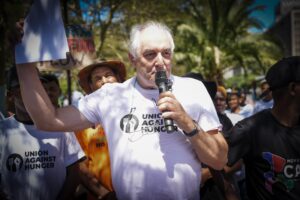
Prof Stephen Devereux holds the SARChI Chair in Social Protection for Food Security , affiliated with the DSTI-NRF Centre of Excellence in Food Security and the University of the Western Cape. Photo Diaulos Media/CoE-FS.
During his 2026 State of the Nation Address on 12 February, President Cyril Ramaphosa announced his chairing of a water crisis committee, signalling government’s commitment to what has plagued many communities in South Africa for years, including those who have grown to expect clean, running water as soon as they turn on their taps.
But what about South Africa’s food and nutrition crisis, one that — for now — does not impact the country’s middle class? What, beyond the Child Support Grant (CSG), an insufficient Social Relief of Distress (SRD) Grant, and a countrywide vaccination campaign to tackle Foot and Mouth Disease (FMD), does government have planned to achieve its goal to end child stunting by 2030?
This was among the talking points during a post-SONA panel discussion, hosted by Newzroom Afrika, and featuring Professor Stephen Devereux, affiliated researcher with the DSTI-NRF Centre of Excellence in Food Security (CoE-FS), and Union Against Hunger (UAH) secretariat member.
Responding to a question about the government’s proactiveness and the sustainability of its solutions, Professor Devereux credited the president and his administration for establishing the water crisis committee and Ramaphosa’s chairing thereof, but noted that this was long overdue and appeared to be in reaction only to middle-class grievances and widespread media coverage.
“We also have a food crisis in this country, which doesn’t affect the middle classes. There’s no national committee or crisis committee around the food and nutrition crisis,” said Devereux.
Combatting stunting
Turning to the president’s statement on child malnutrition and stunting, Devereux — who holds the SARChI Chair in Social Protection for Food Security — commended the president for raising it, and welcomed government’s ambition to “end child stunting by 2030”.
“That would be fantastic”.
“If they achieve that, that will be a wonderful thing because that, for me, [is] the bottom-line indicator of development, where the children are well-nourished,” Devereux affirmed.
But the reality — that we do not, in fact, have well-nourished children — points to the monumental and complex undertaking ahead.
“We’ve had stunting of children under five plateau, flatline or maybe even increasing since 1994. There’s been no reduction in child stunting.”
“What are they going to do about it, is the question,” asked Devereux.
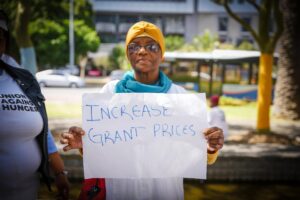
In his SONA analysis, Prof Devereux asked members of government to try living on R370, the amount of the SRD grant. Photo Diaulos Media/CoE-FS.
While the SARChI Chair agreed with President Ramaphosa about the importance of the CSG as a tool with which to combat child stunting, he challenged the notion that the SRD had “lifted millions of South Africans out of food poverty”.
“That’s just not true. The SRD grant is R370. It’s very important for people who get it, but the food poverty line is R855. You can’t buy half of the food that you need to survive with R370.”
How then, Devereux prompted, are we going to solve the food and malnutrition crisis?
Holistic approach
A coordinated strategy is what government will require if it is indeed serious about ending child malnutrition, perhaps even by 2030.
Echoing the call made by the UAH ahead of SONA, and similarly to the hopes expressed by the CoE-FS, a priority is the National Food and Nutrition Security Plan.
“We haven’t had one for three years. There is one about to be published, but it’s been blocked since last year,” noted Devereux.
Aligned to this is the long-awaited Food and Nutrition Security Council, one that the UAH secretariat member hopes the president would also deem fit to chair, so that similar attention is given to food as will be given to water, particularly as the two are inseparable.
“We need an integrated, holistic approach to dealing with the hunger and malnutrition crisis.”
Also required are acknowledgement and response to the fact that the crisis is not about a lack of food. And, despite the prominence given to it in the SONA, even the FMD outbreak is not the cause of a food crisis in South Africa.
“It’s about access to food. Food prices are too high,” said Devereux.
Inaccessible prices
Referring to a statement made by President Ramaphosa in October 2025, Devereux raised the issue of corporate influence on food prices. In his statement, the president called on corporates such as Shoprite, Pick ‘n Pay and other supermarkets to bring down prices, to make food affordable for the poor.
But, some four months later, food prices remain too high, even to those receiving social grants, making the need to support the UAH’s call that “Every household must eat!” even more urgent.

Echoing Union Against Hunger calls, Prof Devereux called on President Cyril Ramaphosa to honour his statement about food retail giants and food prices. Photo Diaulos Media/CoE-FS.
“So, we need to look at the corporates, we need to look at the government, we need to look at the social grants, and, of course, we need to look at economic growth as well.
“Until we have real employment growth — not just social jobs but real jobs — until we have economic growth more than one percent a year, we will not solve this problem of hunger and malnutrition,” said Devereux.
“But it starts at the top, and it starts with the government accepting that we need a focused, coordinated, holistic strategy to deal with hunger and malnutrition in South Africa.”


related Articles
#FoodIndaba2026: Food, water and the return of the Vlei Princess
Professor Julian May is the Director of the DSTI-NRF Centre of Excellence in Food Security (CoE-FS), and holds the UNESCO…
Food affordability symposium: from diagnosis to intervention
Read the article on Day 1 of the “Symposium on Food Prices and Affordability in South Africa” here. Photo Madelene…
US war on Iran could deepen Africa’s food insecurity and instability
Prof Julian May is the Director of the DSTI-NRF Centre of Excellence in Food Security (CoE-FS), which is hosted by…