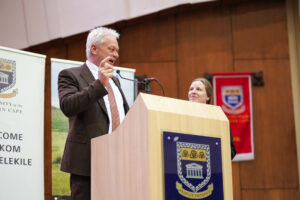
Minister Alois Rainer, head of Germany’s Federal Ministry of Agriculture, Food and Regional Identity, undertook a high-level courtesy and working visit to UWC. Photo Diaulos Media/CoE-FS and UKUDLA.
The DSTI-NRF Centre of Excellence in Food Security (CoE-FS) and the African German Centre for Sustainable and Resilient Food Systems and Applied Agricultural and Food Data Sciences (UKUDLA), recently hosted a high-level diplomatic visit at the University of the Western Cape (UWC). The event welcomed the German Federal Minister of Agriculture, Food and Regional Identity, Minister Alois Rainer, alongside representatives from academia, government and research institutions.
The visit highlighted the importance of international scientific cooperation in addressing global food system challenges, and reaffirmed the longstanding partnership between South Africa and Germany in agricultural research, innovation and capacity development.
In his opening remarks, UWC Rector and Vice-Chancellor Professor Robert Balfour emphasised the importance of global partnerships in strengthening research and training across institutions. Universities, he noted, must not only generate knowledge but also contribute practical solutions that respond to societal challenges.
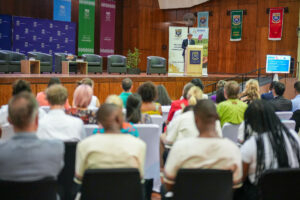
UWC Rector and Vice-Chancellor Professor Robert Balfour delivered the welcome address. Photo Diaulos Media/CoE-FS and UKUDLA.
Initiatives such as the CoE-FS and UKUDLA demonstrate how collaborative research networks can strengthen institutional capacity while building meaningful relationships between universities, governments and communities. Investments in doctoral training, research exchange and academic mobility support stronger research systems and future leadership in food systems transformation.
The collaboration between South Africa and Germany was repeatedly highlighted as an example of how sustained partnerships strengthen institutions and advance research cooperation. Speakers emphasised that international research partnerships are essential not only for advancing knowledge, but also for addressing global priorities such as Sustainable Development Goal 2 on Zero Hunger and Sustainable Development Goal 17 on partnerships for sustainable development. Universities, therefore, play a critical role in contributing practical solutions that respond to the needs of the communities they serve.
Paradox of food insecurity
Professor Julian May, director of the CoE-FS and UKUDLA project leader, presented research examining one of South Africa’s most persistent challenges: the coexistence of strong agricultural production with widespread food insecurity.
South Africa’s agricultural sector produces enough food to feed millions and supports close to 900 000 jobs. Yet, millions of South Africans continue to experience food insecurity, with children disproportionately affected by malnutrition and stunting.
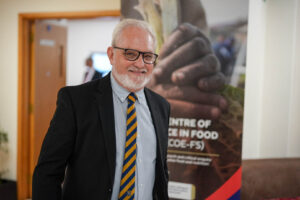
Professor Julian May is the director of the CoE-FS, UKUDLA project leader, and holds the UNESCO Chair in Science and Education for African Food Systems. Photo Diaulos Media/CoE-FS and UKUDLA.
Professor May explained that understanding this paradox requires examining the entire food system, from production and supply chains to food prices, safety and household access to nutritious diets.
“Despite the strength of our agricultural sector, food insecurity persists because of how the food system works, from prices and supply chains, to regulation and access,” said May.
Research conducted through the CoE-FS focuses on three central questions: who is most affected by food insecurity, why it persists despite national food surpluses, and what policy interventions are needed.
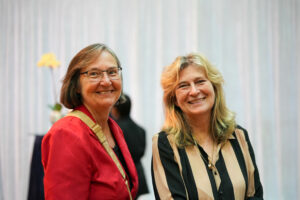
Professor Rina Swart, CoE-FS Nutrition lead, and Professor Lise Korsten, CoE-FS co-director and Food Safety lead, were in attendance. Photo Diaulos Media/CoE-FS and UKUDLA.
This work has informed national policy processes, including the redrafting of South Africa’s Food and Nutrition Security Plan and broader agricultural development strategies. It has also highlighted the important role of small and medium enterprises and informal food traders in supporting household food access.
“Food systems depend on more than good intentions; they require reliable infrastructure, sound engineering and predictable institutions,” the CoE-FS director noted.
Science diplomacy, shared priorities
Minister Alois Rainer’s visit also underscored the broader political and economic relationship between Germany and South Africa, particularly in agriculture, science and food security.
Germany remains one of South Africa’s key international partners in scientific cooperation and agricultural trade. The visit coincided with the 30th anniversary of science and technology cooperation between the two countries, reflected in collaborative initiatives such as UKUDLA.
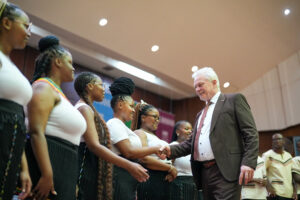
Minister Alois Rainer greets and thanks members of the UWC Creative Choir. The choir opened the proceedings with a performance that set a celebratory tone for the visit and reflected the collaborative spirit underpinning the partnership. Photo Diaulos Media/CoE-FS and UKUDLA.
“Germany and South Africa share a close and trusting partnership built on cooperation in science, agriculture and food security,” said Minister Alois Rainer.
The visit also took place as South Africa assumes a growing leadership role within the G20, where food security and bioeconomy initiatives are key priorities. Participants highlighted the importance of science-based policy advice in shaping these discussions.
Resilience through interdisciplinary research
Professor Clement Nyirenda, UKUDLA co-project leader and director of UWC’s eResearch Office, introduced UKUDLA’s interdisciplinary research agenda, which brings together agriculture, agroecology, engineering and data science to build resilient food systems.
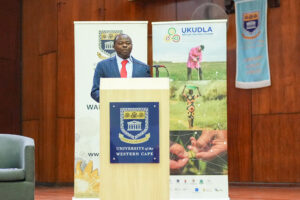
Professor Clement Nyirenda delivered the UKUDLA strategic presentation. Photo Diaulos Media/CoE-FS and UKUDLA.
UKUDLA’s consortium includes universities with diverse institutional histories and strengths, including historically disadvantaged institutions and emerging universities: UWC, the University of Pretoria, University of Mpumalanga, Lilongwe University of Agriculture and Natural Resources, and the University of Hohenheim. This diversity supports strong collaboration across disciplines and institutions.
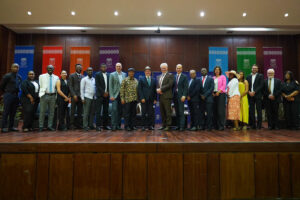
The event brought together diplomats, researchers, students and institutional leaders. Among those in attendance were Dr Ivan Meyer, Western Cape Minister of Agriculture, Economic Development and Tourism; and the German Ambassador to South Africa, Andreas Peschke. Photo Diaulos Media/CoE-FS and UKUDLA.
Nyirenda highlighted initiatives demonstrating how digital innovation can support sustainable agriculture, including the development of a digital twin model of the food ecosystem in the Breede Valley Municipality. Using advanced data modelling, the project aims to inform infrastructure planning, agricultural management and policy decision-making.
Investing in the next generation of researchers
A central theme throughout the visit was the importance of investing in people. Through doctoral training, research exchange and collaborative supervision, UKUDLA and the CoE-FS are developing a new generation of researchers equipped to address complex food system challenges.
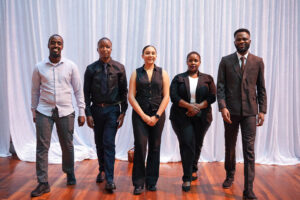
The first cohort of UKUDLA grantees, based at UWC, were in attendance. From left to right: Abdirahman Mohamud, Bonga Baleni, Loren Trerise, Lebogang Moropane, and Pascal Nsunba. Photo Diaulos Media/CoE-FS and UKUDLA.
These programmes allow students to work across institutions and countries, building international research networks while contributing new insights into sustainable agriculture, climate resilience and food system governance.
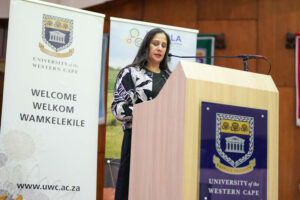
Dr Tasmeera Singh, UWC’s International Relations director, delivered the closing remarks and vote of thanks. Photo Diaulos Media/CoE-FS and UKUDLA.
Closing the event, Dr Tasmeera Singh, Director of UWC’s International Relations department, emphasised that global challenges such as food security require strong partnerships that extend beyond national borders. She underscored the key message of the day, noting that collaborative research networks play a crucial role in strengthening institutions, developing talent and generating knowledge that can support resilient and sustainable food systems.


related Articles
US war on Iran could deepen Africa’s food insecurity and instability
Prof Julian May is the Director of the DSTI-NRF Centre of Excellence in Food Security (CoE-FS), which is hosted by…
Waste as a resource, not a problem: insights from the Breede Valley
For her master’s research, Nolutando Didiza looked at two case studies in the Breede River Municipality: a bioenergy plant that…
Inspiring the next generation of scientists in Grabouw
CoE-FS principal investigator and UKUDLA project co-lead A/Prof Clement Nyirenda participated as a panellist in the discussion about science, education…