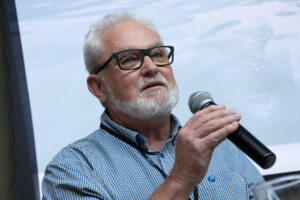
Prof Julian May is the Director of the DSTI-NRF Centre of Excellence in Food Security (CoE-FS), which is hosted by the University of the Western Cape and co-hosted by the University of Pretoria. Photo Alaister Russell/CoE-FS.
As the United States’ war in Iran continues to disrupt supply, and global food prices climb to the highest level in more than three years, Africa will undoubtedly feel the growing pressure, with predicted disruptions to planting season, further fuel and food price increases, and potential food shortages and food-related riots.
Professor Julian May, Director of the DSTI-NRF Centre of Excellence in Food Security (CoE-FS), recently spoke to Al Jazeera English about the impact on the continent.
With the Strait of Hormuz closure already impacting global energy prices and transmitting directly to food and fertiliser prices in Africa, the continent — particularly those countries nearing planting season — will need to ready themselves for strongly affected production levels and potential disruption of the planting season, most notably for crops that are reliant on fertiliser.
According to Professor May, who is based at the University of the Western Cape, the most urbanised economies in Africa are those most vulnerable to both a food and energy shock.
“South Africa [is] one of them, but other countries in Africa have also had very rapid urbanisation … so they will be affected by the cost of transporting food across the continent,” he noted.
Due to an underdeveloped railway system, Africa remains heavily reliant on the use of trucks to transport food from one part of the continent to another. In addition to fuel costs for transportation, Africa is heavily dependent on oil for a range of production issues, including irrigation, production of mechanisation, and refrigeration.
Similarly vulnerable are those African countries that depend on staples such as maize. Where Africa does have an advantage is in its dietary diversity. Areas that use food such as plantain as staples are less likely to be affected by the closure.
Shocks, shortages and riots
Asked whether he anticipates food shortages any time soon, May indicated that in South Africa, concern was beginning to pick up, and was linked to the impact of climate change.
With the country’s heavy reliance on the import of wheat, particularly when experiencing negative climatic effects, the development of a possible El Niño effect is cause for concern. The same is true for other parts of Africa, where imported food is required as a response to climate issues.
“So yes, a food crisis is not impossible.”
And while some African countries, including South Africa, do have the ability to tap into their tax base as a means to somewhat cushion their nations from shock, this kind of government intervention is neither widespread nor sustainable enough to provide the buffer needed to mitigate the impact on African food systems.
In South Africa, the national Treasury attempted to do just that: reducing the fuel levy as a way to buffer South Africans against increasing prices. But in early May, diesel and petrol prices increased anyway.
A further knock-on effect of the US’s war in Iran, the subsequent supply disruption and price increase, is the possibility of social and political instability in Africa. May reminded viewers of the food riots that took place in North Africa a decade ago, as a result of food price increases, and protests in South Africa during the COVID-19 lockdown, as a response to certain regulations, and the closure of shops. As a result, numerous African governments are already expressing concerns about potential instability.
“Food riots are not uncommon in Africa, and particularly in urban communities where there is a politicised population,” said May.
“So there is that risk, yes.”
Watch the full interview here:


related Articles
(Re-advertisement) Science Communication Internship (NQF Level 8)
RE-ADVERTISEMENT: Science Communication Internship (NQF Level 8) Duration: Two years (1 September 2026 – 30 August 2028) Location: Bellville, Cape…
#FoodIndaba2026: Food, water and the return of the Vlei Princess
Professor Julian May is the Director of the DSTI-NRF Centre of Excellence in Food Security (CoE-FS), and holds the UNESCO…
Food affordability symposium: from diagnosis to intervention
Read the article on Day 1 of the “Symposium on Food Prices and Affordability in South Africa” here. Photo Madelene…