
A/Prof Marc Wegerif, CoE-FS principal investigator, served as facilitator for the symposium. Photo Madelene Cronje/CoE-FS.
Rising food prices, deepening food insecurity and the urgent need to move beyond fragmented analysis, toward a shared understanding of food price formation and the coordinated actions required to make food more affordable in South Africa.
This was the purpose of the “Symposium on Food Prices and Affordability in South Africa”, as set out by Dr Andrew Bennie of the Institute for Economic Justice (IEJ), on 23 April 2026, the first of the two-day convening, which took place in Johannesburg.
The Symposium was co-hosted by the DSTI-NRF Centre of Excellence in Food Security (CoE-FS), the IEJ, Just Transitions, and CoE-FS co-host, the University of Pretoria. CoE-FS principal investigators Associate Professor Marc Wegerif and Professor Stephen Devereux served on the Symposium organising committee.

Symposium participants included government representatives, activists, labour, the private sector, and the academic and research community. Photo Madelene Cronje/CoE-FS.
Stakeholders came from across South Africa’s food system: representatives from national and local government, policymakers, activists, labour formations, and the private sector (including street vendors), alongside academics and researchers working across food systems, economics, nutrition, and governance. Together, they used the space to generate practical solutions, including the development of a food affordability policy framework.
Setting the scene
The opening session located affordability within the broader crisis of food and nutrition insecurity in South Africa.
Poverty and high food prices drive hunger. Many households are forced to skip meals, and adults sacrifice their food to feed children in the household. South Africa’s child stunting levels have not decreased since 1994, the consequences of which are lifelong, and 10 000 malnutrition-linked child deaths are recorded annually.

Dr Edzani Mphaphuli, executive director of Grow Great. Photo Madelene Cronje/CoE-FS.
Dr Edzani Mphaphuli, executive director of Grow Great and a leading voice in the Union Against Hunger and Maternal Health Coalition, foregrounded the urgency of rising child malnutrition and stunting.
“We are seeing rising child malnutrition in South Africa. This is not only a nutrition issue; it is a food affordability issue and a policy issue.”
Professor Devereux, who holds the SARChI Chair in Social Protection for Food Security, built on the opening session by offering a food systems perspective on affordability, situating it within the political economy of wages, work, and access.
“We need to think about affordability not only in terms of food prices, but in terms of incomes. Raising incomes is central to improving access to food,” he said.

Prof Stephen Devereux, CoE-FS principal investigator. Photo Madelene Cronje/CoE-FS.
Food prices are shaped across the food system: production (the farm), processing, transport, and retail, and final prices reflect costs and profits across each of these stages. Households make budget-driven choices, often reducing diet quality, and many households cannot afford nutritious food when depending on grants or the minimum wage.
“Where people buy directly from farmers or informal vendors, without layers of distribution and mark-ups, food can be cheaper and often higher quality. Shorter supply chains reduce costs to the consumer,” said Devereux.
Dietary trade-offs
Dr Derek Headey of the International Food Policy Research Institute introduced the international perspective, situating South Africa within global affordability trends.
Headey highlighted that widely consumed processed and sugary foods and drinks, such as biscuits and soft drinks, are often cheaper per 100 calories than healthier options. Drawing on comparative data, he noted that 62% of South Africans cannot afford a healthy diet, compared to 12% in China and 24% in Brazil.
Policy options to begin tackling this include social protection reform, agri-food system investment, and replacing outdated food poverty measures with cost-of-healthy-diet metrics.
Mervyn Abrahams of the Pietermaritzburg Economic Justice and Dignity Group (PMBEJD) grounded the discussion in household-level realities, noting that household food basket prices have risen sharply since 2021, and that food shocks often result in permanent price increases.

Mervyn Abrahams is the programme coordinator at the PMBEJD. Photo Madelene Cronje/CoE-FS.
Drawing on PMBEJD data, he illustrated the scale of the affordability gap: a typical social grants household brings in around R4 043 per month, while the combined cost of basic needs — including electricity, transport to work, domestic and hygiene items, and a basic food basket — can reach approximately R9 486, with food alone costing about R5 443.
“Food price affordability is directly connected to the cost of basic services. When energy and transport costs rise, they crowd out money for food,” said Abrahams.
He emphasised that the minimum wage does not nearly cover the costs of a healthy diet once transport and electricity costs are taken into account. In this context, households are forced to prioritise immediate needs, often compromising on both the quality and quantity of food.
“Women go hungry first so that children can eat. That is what household food-stress looks like.”
Abrahams’ closing provocation captured the central tension: “Are food prices too high or incomes too low?”.
Market, prices and power
Afternoon sessions focused on what determines food prices in South Africa, including inflation, market concentration, and value chain dynamics.
Naledi Radebe, of the National Agricultural Marketing Council highlighted that food inflation is driven by COVID-19 impacts, war shocks, climate risk, disease outbreaks, fuel and fertiliser costs, and logistics failures, with animal proteins and processed foods contributing strongly.

NAMC’s Naledi Radebe highlighted the drivers of food price inflation. Photo Madelene Cronje/CoE-FS.
Kagiso Zwane, senior economist at the Competition Commission of South Africa, emphasised high concentration across seed, storage, trading, and retail, with a few large retailers dominating the food market.

Competition Commission senior economist Kagiso Zwane. Photo Madelene Cronje/CoE-FS.
He also highlighted the context of the “rocket and feather effect”: prices — in particular retail prices — rise fast when costs increase, but fall slowly when costs drop, often settling into a higher price range. This reinforces concerns about food company pricing behaviour and the effects of dramatic pricing fluctuation on food security.
IEJ’s Bennie and Yondela Mahlati examined price formation within maize and wheat value chains. Maize meal prices were identified as essential for poor households as so many eat maize. While maize is not particularly healthy, if households must spend more on maize, it reduces what they have to spend on other foods needed for a balanced diet, thus hurting dietary diversity. Assessing maize prices overtime shows volatility and an overall upward trend, with international maize prices shaping local affordability.
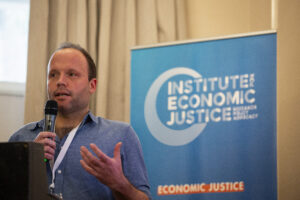
IEJ’s Dr Andrew Bennie. Photo Madelene Cronje/CoE-FS.
They emphasised the need for better data on margins, profits, and cost pass-through, alongside policy options including competition enforcement review, price transparency, buffer stocks, local processing, and diversification to climate-resilient crops.
Across discussions, participants repeatedly returned to the role of information asymmetry, particularly the lack of transparency in pricing data.
“There are significant information asymmetries in the system. Pricing data is often not disclosed, and that creates power in itself,” said Dr Florian Kroll of the CoE-FS.
This was linked to persistent research gaps, including data and specifics on corporate power and pricing behaviour, and limited understanding of pricing strategies in the informal sector.
Dr Stephen Greenberg of Just Transitions highlighted that corporate concentration is high across food sectors, with power concentrated in a few firms shaping affordability outcomes.

Just Transition’s Dr Stephen Greenberg. Photo Madelene Cronje/CoE-FS.
High concentration drives profitability, while small enterprises face barriers to entry, reinforcing structural inequality within the food system. Proposed responses included land reform and redistribution, support for small enterprises and cooperatives, preferential state procurement, and building resilient, shorter supply chains.
Mapping the drivers
To close the day, participants broke into group discussions to identify key drivers, actors, and knowledge gaps.
Drivers of high food prices included liberalised and deregulated markets, corporate concentration, geopolitics, and regulatory challenges, alongside fuel and energy costs. Key actors included corporates with market power, farmers, government departments, and regulatory bodies such as the Competition Commission and consumer protection authorities.

To close the first day, participants discussed drivers, actors and knowledge gaps. Photo Madelene Cronje/CoE-FS.
A strong consensus emerged around the need for better data on profit margins, pricing, and cost structures, stronger competition enforcement and transparency, improved market monitoring, policy interventions such as buffer stocks and local processing, diversification into climate-resilient crops, and a stronger public role in shaping food system outcomes.
There was also shared recognition that food affordability is not only a food system issue, but an economic one, shaped by labour markets, energy systems, global trade, governance structures, and geopolitical shifts.
In closing, Associate Professor Wegerif emphasised the importance of sustaining a collaborative, cross-sectoral approach to both research and policy development.


related Articles
“Umhlabathi impilo” — PhD candidate’s research highlights farmers’ resilience, ingenuity
Njabulo Mncwabe’s research has been a journey into understanding and supporting local food systems in Umbumbulu, KZN, highlighting the resilience…
How indigenous and traditional African foods can shape healthier, more resilient food...
Researchers, civil society representatives, industry partners and government officials gathered in Cape Town for the FAMA Closing Workshop, to reflect…
Food affordability symposium: from diagnosis to intervention
Read the article on Day 1 of the “Symposium on Food Prices and Affordability in South Africa” here. Photo Madelene…