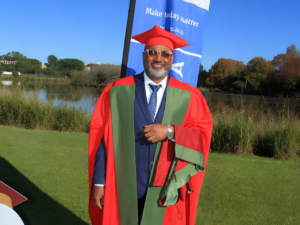
Dr Sami Ali graduated with a PhD in Food Science from CoE-FS co-host institution, the University of Pretoria, where his research explored how fermentation can improve the nutritional quality and shelf life of Kisra, a traditional Sudanese flatbread.
Traditional foods have sustained communities for generations, often long before science could explain why they worked so well. New research by Dr Sami Sidahmed Ali Sidahmed, who recently completed his PhD in Food Science at the University of Pretoria (UP), demonstrates how science can deepen our understanding of these foods, and help strengthen food systems in a changing climate.
Supported during his doctoral studies by the DSTI-NRF Centre of Excellence in Food Security (CoE-FS), Dr Sami Ali investigated how fermentation transforms sorghum flour and improves the quality of Kisra, a traditional fermented flatbread that is eaten daily by millions of people in Sudan. His research provides new scientific evidence that traditional food processing methods can improve nutrition, extend shelf life and enhance the value of climate-resilient African crops.
As Africa’s food systems face growing pressure, including from climate change, Dr Ali’s work highlights the importance of understanding and improving foods that communities already know and trust.
Why Kisra matters
For many people outside Sudan, Kisra may be unfamiliar. Yet, it is one of the country’s most widely consumed staple foods, made simply from sorghum flour and water before undergoing natural fermentation.
“Beyond being a source of energy, Kisra is deeply connected to Sudanese culture, traditions, and family life,” said Ali.
And because it is both affordable and made from locally grown sorghum, it plays an important role in household food and nutrition security.
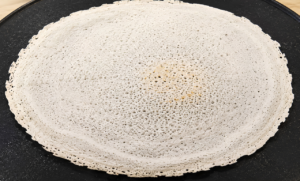
Kisra has been prepared for generations, and remains a staple food for millions of people in Sudan. Dr Ali’s research provides new scientific evidence of the nutritional and functional benefits of its traditional fermentation process.
Sorghum itself has attracted increasing attention from food systems researchers because of its resilience. Unlike many cereal crops, it performs well under hot, dry conditions, making it particularly valuable as climate change places increasing strain on Africa’s food systems.
As a drought-tolerant crop that provides carbohydrates, protein, minerals and essential nutrients, sorghum has significant potential to contribute to more resilient and sustainable food systems.
Fermentation under the microscope
While fermentation has been used for centuries to prepare foods like Kisra, Ali wanted to understand exactly what happens during the process and whether those traditional practices deliver measurable nutritional benefits.
Explaining the process in simple terms, Ali said: “Fermentation is like letting tiny helpful microorganisms work on the flour to make the food healthier, tastier, and stay fresh for longer”.
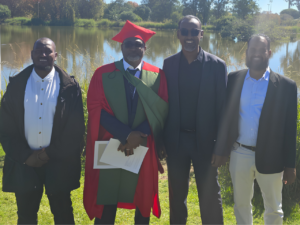
Graduation day marked both a personal milestone for Dr Ali, and was the completion of research with important implications for food and nutrition security in Africa.
Ali’s research found that fermentation significantly improved the digestibility of both proteins and starch, making nutrients more available to the body. It also enhanced the functional properties of the batter and extended the shelf life of the final product.
Perhaps most significantly, the research demonstrated how fermentation alters the starch-protein structure in sorghum flour, improving both quality and nutritional characteristics.
“It was encouraging to see that a traditional process used for generations has measurable scientific benefits,” he remarked.
A journey shaped by resilience
One of Ali’s proudest moments was publishing his first scientific paper. Another was completing experiments that advance the understanding and value of this important African traditional food.
But, completing a PhD is rarely straightforward, and Ali’s journey presented both scientific and personal challenges.
Behind the scientific findings were years of painstaking laboratory work. Experiments had to be repeated, methods refined, and new disciplines mastered, including food chemistry, microbiology, rheology and nutritional analysis; he needed to continually develop new technical skills and approaches to problem-solving.
“These challenges ultimately strengthened my problem-solving skills and resilience as a researcher.”
Challenges, however, extended well beyond the laboratory. As war broke out in Sudan, Ali’s original financial support was disrupted, placing both his research and academic future at risk. At one of the most uncertain moments of his PhD, support from the CoE-FS allowed him to continue his work rather than abandon it.
“The support from the DSTI-NRF Centre of Excellence in Food Security was extremely important to me, both personally and professionally,” he reflected.
“At a very difficult time, the Centre’s support helped me continue my studies and focus on completing my research without having to abandon my academic goals.”
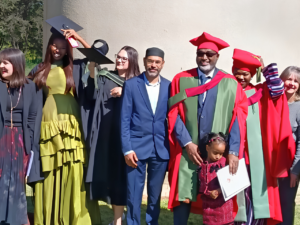
Dr Ali celebrates with fellow UP graduates, and his supervisor Professor Naushad Emmambux, after completing his PhD in Food Science.
The CoE-FS’s support enabled him to access research resources, conduct experiments, attend and participate in research activities, and engage with a network of researchers working on food security issues. Equally important, it provided stability during an exceptionally difficult period in his life.
Alongside the support of the CoE-FS, Ali is “deeply grateful” for his community: his supervisors, including CoE-FS Principal Investigator Professor Naushad Emmambux, mentors, colleagues, and fellow students at UP.
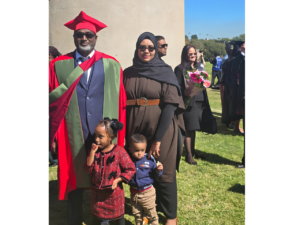
The unwavering support of Dr Ali’s family helped him navigate the challenges of completing his PhD.
“I am especially thankful to my family, particularly my wife and daughter, whose encouragement, patience, and sacrifices helped me stay focused and motivated,” expressed Ali.
“Their support was invaluable throughout my PhD studies.”
Looking ahead
Now that he has completed his PhD, Ali hopes to continue building on this work through postdoctoral research and collaborative projects focused on food science, fermentation, food security and the sustainable processing of African crops.
His long-term ambition is to bridge scientific research and industry applications to develop nutritious, affordable and sustainable food products while mentoring future researchers entering the field.
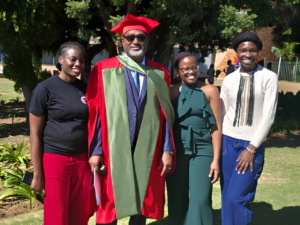
Dr Ali’s advice to students is “stay curious, be patient, and remain persistent when facing setbacks”.
His advice to aspiring postgraduates reflects the perseverance that defined his own journey.
“A PhD is a challenging but rewarding journey,” said Ali. “My advice is to stay curious, be patient, and remain persistent when facing setbacks.”
And while research rarely goes exactly as planned, challenges often lead to valuable discoveries.
“Build strong relationships with supervisors and colleagues, seek opportunities to learn new skills, and remember that every small step contributes to the final achievement,” he encouraged.
“Most importantly, choose a research topic that genuinely interests you because passion and perseverance are essential for success.”
By helping explain why a traditional food performs so well, Ali hopes his research will contribute to the development of nutritious, affordable and sustainable food products based on African crops. His work shows that solutions to future food security challenges may already exist in foods that communities have prepared for generations — provided we continue investing in both the science and the scientists needed to understand them.


related Articles
How indigenous and traditional African foods can shape healthier, more resilient food...
Researchers, civil society representatives, industry partners and government officials gathered in Cape Town for the FAMA Closing Workshop, to reflect…
CoE-FS grantee develops new gluten-free food solution
CoE-FS grantee Daddy Kgonothi’s invention makes going gluten-free more affordable. Photo Je’nine May/CoE-FS. Research supported by the DSTI-NRF Centre of…
Two CoE-FS programme leads are finalists in South Africa’s prestigious ‘Science Oscars’
Two CoE-FS PIs, Prof Rina Swart and Prof Naushad Emmambux, and two CoE-FS affiliated researchers, Prof Mary Scholes and Prof…