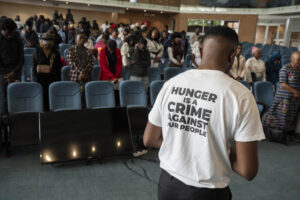
The Youth Against Hunger (YAH) Indaba brought together students, unemployed youth, activists, and volunteers. Photo Ihsaan Haffejee/CoE-FS.
For some young people, hunger means changing how often they eat. For others, it means working without pay, carrying the needs of an entire family, or choosing between their own basic needs and those of their siblings. And for students, hunger can mean sitting in a classroom unable to concentrate.
At the recent launch of the Youth Against Hunger (YAH), young people from across Gauteng and Cape Town confronted this hunger, which is often shrouded in shame. The YAH Indaba, which took place in Johannesburg in early September, brought together students, unemployed youth, activists, and volunteers to share and hear what hunger looks and feels like, and what needs to be done.
YAH is a new, youth-led and focused social movement, and a partner association of the Union Against Hunger (UAH).

Dr Busiso Moyo is a member of the Union Against Hunger (UAH) secretariat, a CoE-FS grantee and postdoctoral researcher at the University of the Western Cape. Photo Ihsaan Haffejee/CoE-FS.
Right from the start, youth set the tone, speaking openly about what hunger looks and feels like in their lives. They shared how it affects every facet of their lives, including, on the part of the students present, their ability to focus on studies.
Sharing the student perspective, and delving into the countrywide issue of student hunger, was a strong delegation from the University of the Western Cape (UWC) and the University of Cape Town (UCT). Student Representative Council (SRC) President Mcntosh Khasembe, student leader Onesimo Mvela, Gabriella Oliver, Siphokuhle Gcina, Mbalentle Mafai, and T. Remoneilwe Mogatosi made up the UWC delegation. They were joined by Lesego Senokoanyane, a UCT student, working in UCT’s Food Sovereignty Programme.

A strong delegation from UWC and the University of Cape Town attended the YAH Indaba, joining fellow young people, and students from the University of Pretoria, the University of South Africa and the Tshwane University of Technology, among others. Photo Ihsaan Haffejee/CoE-FS.
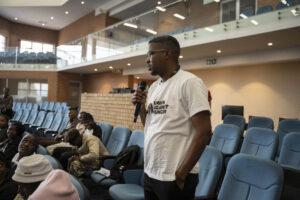
UWC PhD researcher and CoE-FS alumnus T. Remoneilwe Mogatosi joined the Cape Town delegation. Photo Ihsaan Haffejee/CoE-FS.
The delegation’s participation was funded and supported by the SA/UK Bilateral Research Chair in Social Protection for Food Security, affiliated with the DSTI-NRF Centre of Excellence in Food Security (CoE-FS), and held by Professor Stephen Devereux.
Hunger hearing
Leading the second panel discussion of the day, UWC’s Oliver introduced the “Manifesto Against Student Hunger”, which emerged from the Hunger Hearing held at UWC in August 2025. The aim of the session was to mobilise towards a nationwide student-led initiative that deals with hunger on campuses.
“But I don’t want this session to only be about UWC; I want to hear what is happening at your universities as well,” said Oliver.

UWC PhD researcher Gabriella Oliver led the panel discussion on the “Adoption of the Youth Against Hunger Declaration”. Photo Ihsaan Haffejee/CoE-FS.
A student from the University of South Africa (UNISA) shared how they use their book allowance to support their families.
“With every single financial assistance that I get, such as my book allowance, I’m unable to buy stationery or any materials to deal with my school stuff. I have to support two households: my grandmother’s and my mother’s house. So, it becomes a new issue,” the UNISA student said.
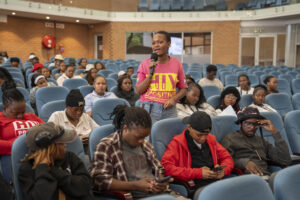
Young people shared how hunger, which is often shrouded in shame, affects every facet of their lives. Photo Ihsaan Haffejee/CoE-FS.
Another student, from the Tshwane University of Technology (TUT) added that students needed to be empowered, to manage whatever money they have.
“Most of the students, if they are not knowledgeable in how to handle money, don’t know how to separate their needs and wants.”
Structural, sustainable interventions
Student leadership at the Indaba lauded efforts at their respective universities, but questioned sustainability and whether these address broader structural challenges that drive student hunger.
The University of Johannesburg’s (UJ) SRC deputy president recognised the important role of UJ’s meal assistance initiative, which currently benefits more than 6 000 students every month, and includes grocery packs that allow students to cook for themselves. However, the SRC leader also raised concerns about the initiative’s sustainability.

UWC SRC President Mcntosh Khasembe shared details of the university’s ‘Feed the Need’ campaign. Photo Ihsaan Haffejee/CoE-FS.
Khasembe, UWC’s SRC president, introduced the audience to UWC’s ‘Feed the Need’ campaign, which aims to combat student hunger, specifically in regards to delays in the dissemination of National Student Financial Aid Scheme (NSFAS) funds. But he also went beyond university campuses.
“Is the State giving us food? I don’t think that’s the question we should be asking ourselves.”
“The question we should be asking is that, ‘Is the current framework and the resources that the State is giving us enough and sufficient for the number and the rate of people that are food-insecure in the country’?”.
These conversations coalesced into a fundamental question: What can be done to ensure food security for students?
Towards a nationwide movement
Oliver emphasised the need for collaborative efforts across all campuses in the country:
“What I’m hearing from everyone in the audience is that although our universities may be very different, there are common experiences, whether it’s affordability, whether it’s funding or access to food, residence, information, stigma or institutional support.”
She urged students and young people to go beyond the adoption of declarations, urging action and activism, even when these do not render immediate results.
“But I think we also need to be careful about something, and that is that adopting a declaration is not the same as solving a problem,” Oliver added.
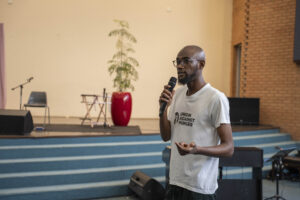
University of Pretoria PhD researcher and CoE-FS grantee Oscar Sithole is part of the YAH organising committee. Photo Ihsaan Haffejee/CoE-FS.
Oscar Sithole, a UAH member and a CoE-FS grantee based at the University of Pretoria (UP), collated the ideas proposed by attendees. Some of the solutions from the YAH Indaba include:
- Increase the Social Relief of Distress (SRD) grant to the Food Poverty Line
- Make the SRD grant a universal grant
- Increase the NSFAS food allowance to match the ever-escalating Food Price Inflation
- Establish Food and Nutrition Officers/portfolios in SRCs or student governing bodies
- Extend the National School Nutrition Programme to colleges and universities
- Introduce a programme that keeps the prices of certain essential/basic food items (“best-buy staples”) affordable for students at colleges and universities, as well as people who receive the SRD grant
- Institutions of higher learning should use their available land to establish food gardens
- Tribal leaders and local municipalities should reserve land for youth for production and link them to markets to create employment
- Establish and expand Food Aid Programmes like the Student Nutrition and Progress Programme (SNAPP) at UP.
The YAH will continue to mobilise youth against hunger. For the UWC and UCT students, this was a step towards eradicating hunger on their campuses. The students have committed to continue advocating and mobilising fellow students against hunger through building networks and partnerships.
To join Youth Against Hunger, or to support their work, please contact the YAH Organising Committee on yah@unionagainsthunger.org.


related Articles
SONA 2026: Coordinated strategy needed to deal with food and malnutrition crisis
Prof Stephen Devereux holds the SARChI Chair in Social Protection for Food Security , affiliated with the DSTI-NRF Centre of…
What would an anti-hunger budget have looked like?
Dr Busiso Moyo is a postdoctoral researcher with Union Against Hunger (UAH) founder-member, the DSTI-NRF Centre of Excellence in Food…
Union Against Hunger: Academia, civil society join forces to combat a ‘slow...
The Union Against Hunger is a coalition of forces from academia and civil society. Photo Alaister Russell/CoE-FS. The recently launched…