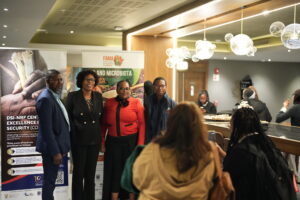
Researchers, civil society representatives, industry partners and government officials gathered in Cape Town for the FAMA Closing Workshop, to reflect on two years of collaboration and chart a way forward for indigenous and traditional African foods. Photo Diaulos Media/CoE-FS.
The Food and Microbiota in Africa (FAMA) Project recently reached an important milestone, as the researchers, civil society representatives, industry partners and government officials who had been part of the journey gathered in Cape Town for the Closing Workshop, to reflect on two years of collaboration and chart a way forward for indigenous and traditional African foods.
The FAMA Project is supported by the French Embassy in South Africa, and the French Agricultural Research Centre for International Development (CIRAD). The Closing Workshop, which was co-hosted by the DSTI-NRF Centre of Excellence in Food Security (CoE-FS), FAMA, and the French Embassy, celebrated a partnership that has brought together institutions and communities from across South Africa, Senegal and France.
FAMA was established within the “Transforming Food Systems and Agriculture through Research in Partnership with Africa” (TSARA) initiative, to investigate an increasingly urgent question: how can indigenous and traditional African foods contribute to healthier diets while strengthening sustainable food systems in Africa?

Dr Tasmeera Singh, Director of International Relations at UWC, reaffirmed the university’s commitment to international research partnerships that address pressing societal challenges. Photo Diaulos Media/CoE-FS.
At a time when rapid urbanisation and changing lifestyles are driving greater consumption of ultra-processed foods (UPFs), researchers sought to better understand the links between traditional diets, gut microbiota and long-term health. Rather than focusing solely on nutrition, FAMA, alongside farmers and processors, examined the entire food system, from production and processing to consumer behaviour, food environments and policy.
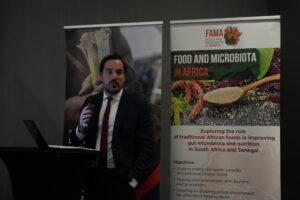
Alex Lavaud, Deputy Consul at the French Consulate in Cape Town, reflected on the importance of collaboration in addressing Africa’s triple burden of malnutrition. Photo Diaulos Media/CoE-FS.
Throughout the Closing Workshop, speakers highlighted the project’s scientific achievements while emphasising that its greatest impact lies in connecting research with policy, practice and communities.
Indigenous foods’ potential
Welcoming delegates on behalf of the University of the Western Cape (UWC), where FAMA is hosted, Dr Tasmeera Singh, Director of International Relations, reaffirmed UWC’s commitment to international research partnerships that address pressing societal challenges. She was joined by Alex Lavaud, Deputy Consul at the French Consulate in Cape Town, who reflected on the importance of the collaboration in addressing Africa’s triple burden of malnutrition. Professor Lise Korsten, Co-Director and Food Safety lead at the CoE-FS, highlighted FAMA as an example of the interdisciplinary partnerships needed to transform contemporary food systems.
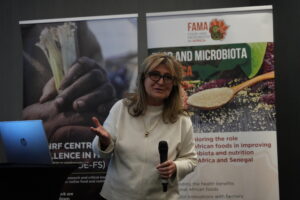
CoE-FS Co-Director Prof Lise Korsten highlighted FAMA as an example of the interdisciplinary partnerships needed to transform contemporary food systems. Photo Diaulos Media/CoE-FS.
Dr Arlène Alpha, CIRAD Senior Researcher and CoE-FS and FAMA Project Lead, outlined FAMA’s multidisciplinary approach, which investigated four traditional African plant-based foods — including sorghum-based products such as motoho, and amaranth — across communities in South Africa (Amadiba in the Eastern Cape and Obanjeni in KwaZulu-Natal) and Senegal (Dakar).
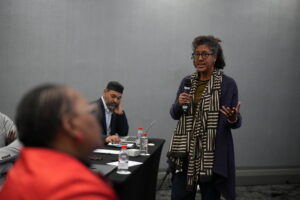
Dr Arlène Alpha, CIRAD Senior Researcher and CoE-FS and FAMA Project Lead, outlined FAMA’s multidisciplinary approach. Photo Diaulos Media/CoE-FS.
The research combined consumer studies, microbiome analysis, food processing research and policy engagement to generate evidence that could support healthier diets while creating opportunities for farmers, processors and small businesses.
The scientific sessions demonstrated both the promise and the complexity of revitalising indigenous foods. Research presented by CoE-FS Nutrition lead Professor Rina Swart showed that while many South Africans in the targeted communities recognise the health benefits of traditional foods, younger generations are becoming less familiar with them as urbanisation and modern lifestyles reshape food preferences.
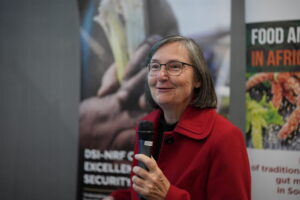
Prof Rina Swart is the Nutrition lead at the CoE-FS. Photo Diaulos Media/CoE-FS.
In contrast, findings presented by Dr Moustapha Seye from the Laboratory for Research on Economic and Social Transformations (LARTES-IFAN) at Cheikh Anta Diop University of Dakar, suggested that, in Senegal, traditional dishes are experiencing renewed interest and are compatible with modern lifestyle, with consumers increasingly associating them with health and nutrition rather than simply cultural heritage.
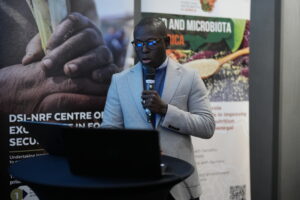
Dr Moustapha Seye from the Laboratory for Research on Economic and Social Transformations (LARTES-IFAN) at Cheikh Anta Diop University of Dakar. Photo Diaulos Media/CoE-FS.
Together, the studies illustrated how perceptions of indigenous foods are changing across different African contexts and underscored the need to better understand the social and cultural drivers of food choice.
Presentations also explored the emerging science linking traditional diets and gut microbiota. Professor Emmanuelle Maguin, from France’s National Research Institute for Agriculture, Food and Environment (INRAE), highlighted growing evidence that — like Mediterranean diets — diverse, plant-rich African diets support healthier microbial communities than highly processed Westernised diets.

Prof Emmanuelle Maguin, from INRAE, highlighted growing evidence that — like Mediterranean diets — diverse, plant-rich African diets support healthier microbial communities. Photo Diaulos Media/CoE-FS.
Analyses based on in-vitro digestion of food samples and their impact on two donors’ gut microbiota showed that traditional African foods positively influence the gut microbiota, although results vary depending on the foods, the in-vitro digestion procedure used and the donor.
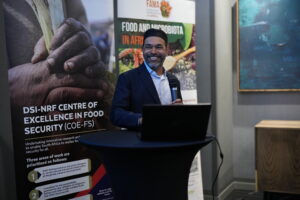
Prof Naushad Emmambux is a co-PI for the CoE-FS’s Technological Innovation programme. Photo Diaulos Media/CoE-FS.
Providing a food science perspective, CoE-FS Principal Investigator (PI) Professor Naushad Emmambux demonstrated how traditional crops such as sorghum can be developed into products that retain nutritional benefits — especially lower glycemic indices – while meeting the convenience needs of urban consumers. Speakers agreed that stronger scientific evidence will be essential for supporting future health claims, increasing consumer confidence and encouraging wider commercial uptake of indigenous foods.
Evidence into action
Attention then shifted from research findings to practical innovation. Using consumer and farmer surveys in the South African communities, Dr Joaquin Ameller from CIRAD revealed the importance of self-production and wild harvesting in accessing indigenous and traditional foods, suggesting that supporting these foods requires going beyond market focus.
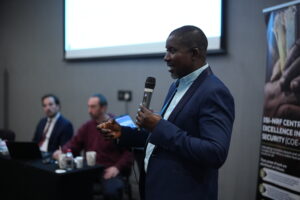
Dr Lodama Kafua from the Agricultural Research Council. Photo Diaulos Media/CoE-FS.
Presentations from partners including Dr Lodama Kafua from the Agricultural Research Council, Dr Nomusa Dlamini from the Council for Scientific and Industrial Research and Remi Piot from Chipkins Puratos showcased work with farmers and small enterprises to improve indigenous crop production, strengthen agro-processing and develop new food products.
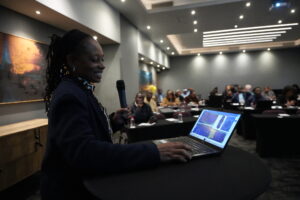
Dr Nomusa Dlamini from the Council for Scientific and Industrial Research. Photo Diaulos Media/CoE-FS.
Discussions highlighted both the opportunities and the challenges facing indigenous food value chains, including access to seed, production knowledge, processing technologies, financing and markets to meet increasing demand. Participants stressed that strengthening these value chains is essential for improving nutrition and for supporting rural livelihoods and building climate-resilient agriculture.
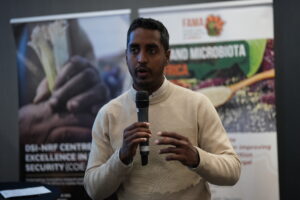
Remi Piot from Chipkins Puratos. Photo Diaulos Media/CoE-FS.
The afternoon sessions examined the policy and institutional landscape surrounding indigenous foods. Dr Florian Kroll, Project Lead at the CoE-FS, argued that despite growing recognition of their nutritional and environmental value, state support to indigenous and traditional foods remains limited, constrained by fragmented governance systems and policy frameworks that prioritise commodity agriculture over diversified local food systems. The discussion called for stronger coordination between government, researchers, industry and civil society to ensure that scientific evidence is translated into practical policy interventions that support both producers and consumers.
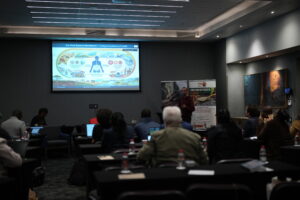
Dr Florian Kroll, CoE-FS Project Lead, served as facilitator for the day, and presented on the policy and institutional landscape of indigenous and traditional foods. Photo Diaulos Media/CoE-FS.
The closing roundtable focused firmly on the future. Joining the roundtable were CoE-FS PI Professor Ndiko Ludidi, Sinegugu Zukulu of the Amadiba Crisis Committee, Penny Campbell from the Department of Health, Sibongiseni Ndimane from the Department of Agriculture, and Khuliswa Mazizi, who heads up an SMME producing traditional foods.
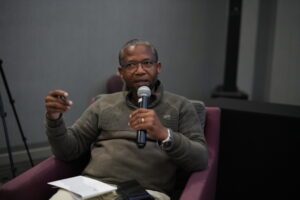
Prof Ndiko Ludidi is a co-PI for the CoE-FS’s Technological Innovation programme, and Dean of the Faculty of Agriculture and Natural Sciences at the University of Mpumalanga. Photo Diaulos Media/CoE-FS.
The roundtable discussion identified priorities that extend well beyond the lifespan of the FAMA Project, including expanding community seed banks, supporting small businesses developing indigenous and traditional food products, developing public procurement using these foods (eg schools), strengthening collaboration between government departments, completing outstanding microbiota research, protecting intellectual property rights, and developing evidence-based pathways for future health claims relating to indigenous and traditional foods.
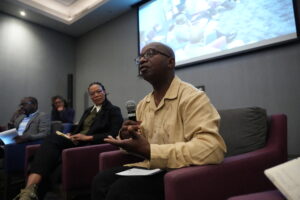
Panellists discussed the way forward for indigenous and traditional foods. Photo Diaulos Media/CoE-FS.
There was broad agreement that continued collaboration across research, government, industry and civil society will be essential if indigenous foods are to play a more prominent role in healthier, more resilient African food systems.
Beyond the project
A recurring theme throughout the workshop was that communication will play a critical role in the next phase of this work. Participants emphasised the need to improve public understanding of indigenous foods, particularly among children and young people, while making research findings more accessible to policymakers, health professionals and communities.
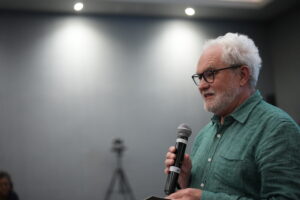
Prof Julian May, Director of the CoE-FS, delivered the closing remarks. Photo Diaulos Media/CoE-FS.
The CoE-FS committed to working with project partners to develop communication resources that promote the nutritional and health benefits of indigenous and traditional foods through schools, clinics and public awareness campaigns.
While the workshop marked the formal conclusion of the FAMA Project, it also reinforced the enduring value of international partnerships that bring together diverse expertise to address complex food systems challenges. By generating new evidence on indigenous and traditional foods and gut health, strengthening collaboration across three countries, and creating stronger links between science, policy and practice, FAMA has laid an important foundation for future research and action. As discussions throughout the day made clear, the work of transforming African food systems — and restoring indigenous and traditional foods to their rightful place within them — is only just beginning.


related Articles
Ancient practice, new evidence: research reveals the value of fermented Kisra
Dr Sami Ali graduated with a PhD in Food Science from CoE-FS co-host institution, the University of Pretoria, where his…
CoE-FS grantee develops new gluten-free food solution
CoE-FS grantee Daddy Kgonothi’s invention makes going gluten-free more affordable. Photo Je’nine May/CoE-FS. Research supported by the DSTI-NRF Centre of…
Advancing a food affordability policy agenda in South Africa
A/Prof Marc Wegerif, CoE-FS principal investigator, served as facilitator for the symposium. Photo Madelene Cronje/CoE-FS. Rising food prices, deepening food…