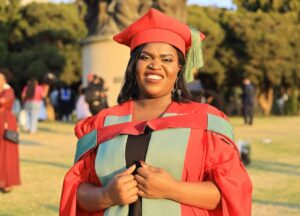
CoE-FS grantee Dr Tintswalo Molelekoa graduated with a PhD in Plant Pathology in September 2026, from CoE-FS co-host, the University of Pretoria. Photo Supplied.
As a young child in Thapane Village in Tzaneen, Limpopo, Tintswalo Molelekoa didn’t even know universities or colleges existed. And following a childhood fire accident, doubts about her ability to learn were raised. But with the help of a caring teacher, who secured an application for the young Tintswalo, she defied the odds stacked against her and was accepted to the University of Pretoria (UP) within a month of submission.
Today, that little girl from Thapane is Dr Molelekoa, having graduated in September 2026 with a PhD in Plant Pathology from UP.
It is a remarkable achievement that crowns a decade-long academic journey marked by faith, determination, perseverance, adaptability, and an unshakeable commitment to improving food security for the most vulnerable communities in South Africa.
When Dr Molelekoa enrolled at UP in 2013 for a degree in Biological Sciences, she became the first in her family to enter higher education. A BSc was not her first choice though; she wanted to study Pharmacy but the option was unavailable.
“Pharmacy, Medicine and Engineering were among my main choices because I had studied Science at school, and these were some of the common career paths people assumed learners who took Science should pursue, said Molelekoa.
“I had very little exposure to the wide range of opportunities available within the sciences, so I did not yet know what other options were available to me.”
A year into her degree, and after rigorously engaging her university about the career and academic prospects in her field, Molelekoa finally fell in love with her “second choice”. In December of that year, she returned home for vacation and realised that the mangoes she had planted earlier in the year had not ripened.
“It was so weird … There was this white thing around the mangoes,” she recalled.
It was at this moment that Molelekoa’s interest in Plant Pathology truly piqued. She returned to Pretoria, where she completed her four-year BSc in 2016, top of the class.
In her fourth and final year, she chose a food safety research project funded by the DSTI-NRF Centre of Excellence in Food Security (CoE-FS). The project was supervised by Professor Lise Korsten, co-director of the CoE-FS, and the Centre’s Food Safety lead.
“I was drawn to Professor Korsten’s energy in the classroom and became fascinated by her work in international plant pathology projects,” said the CoE-FS grantee.
The chosen topic became the foundation for her MSc in Agriculture, and Professor Korsten, a steadfast supporter throughout Molelekoa’s research journey.
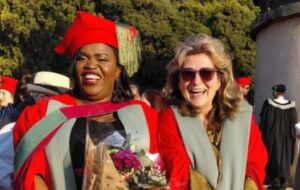
Dr Molelekoa’s desire to work with Prof Korsten has developed into a genuine fascination with food safety, an interest that has continued to shape the CoE-FS grantee’s research journey. Photo Supplied.
But Molelekoa’s MSc journey came with significant academic, logistical and personal challenges. The research was conducted after xenophobic violence in Ivory Park, making access to households and establishing trust with participants particularly difficult. A then-20-year-old researcher, Molelekoa approached her local church in Ivory Park and her sister’s church in Atteridgeville for assistance in connecting her with families. But even then, challenges persisted, including issues with transportation, many of the participating families were working and unavailable for daytime sampling, and unforeseen costs that Molelekoa often had to pay from her own pocket.
Then, in November 2019, as she began writing her dissertation, Molelekoa found out she was pregnant with her first child. Determined, she wrote her dissertation while pregnant, submitted it, made the necessary revisions, re-submitted, and, one week later, delivered her firstborn. And as if that wasn’t reason enough for celebration, new-mother Molelekoa was awarded her degree, cum laude.
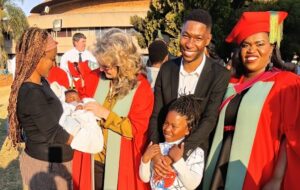
Dr Molelekoa gave birth to her first-born a week after the final submission of her master’s dissertation, and to her second child during her PhD journey. Photo Supplied.
During her CoE-FS-funded MSc project, which focused on tomato crops, Molelekoa noticed that a significant number of tomatoes collected from participating households had spoiled. This motivated her to investigate the relationship between food safety and postharvest spoilage, the initial focus of her PhD research; the “first choice”. But, yet again, she was forced to alter her plans, due to a change in supervision. With the decision to hone in on postharvest spoilage, Molelekoa embarked on her PhD journey, at the height of the COVID-19 pandemic.
Despite the many challenges associated with the pandemic and lockdown, all seemed to be on track: proposal submitted and approved, ethics clearance obtained, and sampling about to start. Then, the farmers included in the study pulled out.
“I assumed it was because they were based in Gauteng, which was one of the provinces most heavily affected by COVID-19 and, at various stages, the epicentre of the pandemic in South Africa,” said Molelekoa.
And while unsure of the precise reasons for their withdrawal, Molelekoa — now adept at adapting to ever-changing circumstances — reimagined and restructured her study; the now-trusty “second choice” all over again.
The focus shifted to postharvest decay and spoilage of tomatoes from small-scale production systems. Tomatoes are a staple crop for many rural and food-insecure households. Molelekoa aimed to understand why tomato produce rots so quickly, and what practical and environmentally friendly solutions existed, to reduce losses, enhance food security and improved farmer livelihoods.
“We wanted to make sure that people have enough food to eat,” she said.
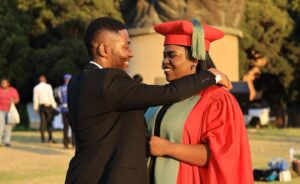
Support from her husband has been integral to Dr Molelekoa’s success: he drove her to farms, helped with logistics and was a source of constant encouragement. Photo Supplied.
During her master’s studies, Molelekoa’s direct interaction with producers, handlers and sellers was limited. Her PhD research, which involved Knowledge, Attitudes and Practices (KAP) research methodology, brought her into direct and frequent contact with informal-sector food system actors and consumers, and the daily challenges they faced.
“I fell in love with working with people on the ground,” said Molelekoa.
This direct engagement changed the way the CoE-FS grantee understood the purpose and potential impact of research. She began to see research as more than producing data and publications; it was also about listening to, understanding and working alongside the people who produce, handle, sell and consume food.
Molelekoa’s research identified challenges faced by small-scale farmers and translated these findings into actionable changes. Her advice included later planting dates, to better avoid Gauteng’s rainy season and the associated risks of crop damage and losses. At least four farmers reported an extension of their main harvest season and maintaining production for longer.
“We went into food security, and we achieved it,” Molelekoa said proudly.
One of the important lessons the UP graduate has taken from this is that food loss begins in the field, and reducing losses cannot focus only on what happens after harvest. While postharvest losses still require investment in appropriate infrastructure, storage and handling systems, some losses can be reduced by adapting production practices to local environmental conditions.
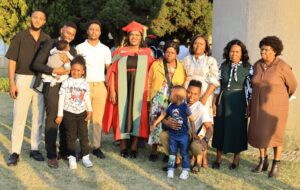
Dr Molelekoa’s success is evidence that, with the right support system, motherhood is not a barrier to academic excellence. Photo Supplied.
In addition to learning to adapt during her academic journey, Molelekoa has also needed to juggle motherhood, personal loss and grief, and many obstacles while pursuing her degrees. With delivery of her first-born just a week after submitting her MSc dissertation, Molelekoa also spent her entire PhD journey as both a new mother and then, a mother of two.
“Being a young mother … a couple of times I was in the hospital with a small baby. That was a scary time,” she recalled.
There were very many late nights, early mornings and, on one occasion, having to continue her writing while tending to her sick child in hospital. But Molelekoa has never allowed these challenges to define her or weigh her down. With clear goals, stringent routines, and the mantra “I can do it”, she pushed ahead.
A key contributor to her success is her support system, which Molelekoa, a church youth leader, describes as “God-stationed”. Her husband, an academic himself, drove her to farms, helped with logistics and was a source of constant encouragement.
Female supervisors who had experience trying to balance motherhood and academia — including Dr Stacey Duvenage, Dr Erika du Plessis, Dr Jarishma Gokul, Dr Nazareth Siyoum, and Professor Korsten — provided both professional guidance and personal empathy.
Molelekoa’s students, farmer participants and colleagues stepped in during critical moments, some even sacrificing their December holidays to help process samples. A particularly moving moment came when her project manager, Ms Boikanyo went beyond what is usually expected in the workplace, and offered support and care after Molelekoa experienced personal loss during her studies.
“I had a lot of challenges, but my support system really carried me through.”
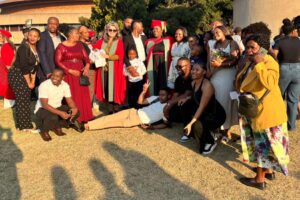
Dr Molelekoa with members of her “God-stationed” support system. Photo Supplied.
Throughout her academic journey, Molelekoa has remained committed and deeply rooted to the communities she’s engaged with. She’s conducted farmer training, involved industry and government stakeholders, and saw direct changes in farming practices, including the tomato farmers who had once lost entire crops and were now producing more successfully after adopting her recommendations.
And her journey with the CoE-FS, which began during her fourth year, continues. As a postdoctoral researcher, Molelekoa continues to oversee CoE-FS Food Safety projects, and — playing her part in building capacity — mentoring students.
“Food security, food security, food security, food security. That’s the core part of my work,” she said.
Reflecting on the journey to her PhD, Molelekoa points out a few learnings: with the right support system, motherhood is not a barrier to academic excellence; research conducted with communities — not just about them — creates lasting change; and oftentimes, the “second choice” is indeed the best choice.
Her closing message to fellow young women and emerging researchers in the Global South is one of faith, tenacity and community: “I can do it. I can do it. I can do it.”


related Articles
Public Protector’s report an opportunity to strengthen SA’s food safety system
During a recent Newzroom Afrika interview, Professor Lise Korsten discussed the public protector’s preliminary report into food safety in…
From burden to solutions: World Food Safety Day highlights importance of food...
The World Food Safety Day event was co-hosted by the University of Pretoria’s (UP) Department of Residence Affairs and Accommodation…
CoE-FS Co-Director Professor Lise Korsten honoured with 2025 NSTF–South32 Lifetime Achievement Award
The DSTI-NRF Centre of Excellence in Food Security (CoE-FS) is proud to celebrate a major national honour awarded to our…