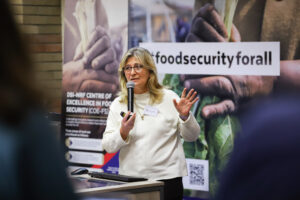
During a recent Newzroom Afrika interview, Professor Lise Korsten discussed the public protector’s preliminary report into food safety in the informal trading sector. Photo Je’nine May/CoE-FS.
The release of the Public Protector’s report into food safety failures should mark the beginning of coordinated national action to strengthen South Africa’s food safety system, according to Professor Lise Korsten, Co-Director and Food Safety Lead at the DSTI-NRF Centre of Excellence in Food Security (CoE-FS).
Speaking to Newzroom Afrika, Professor Korsten described the report as an important foundation for government, regulators and other stakeholders to move beyond discussion and towards implementation.
“I’ve read it … it’s an excellent report. It’s much needed. We need it right now,” she said, noting that the report provides an opportunity for state institutions to respond collectively and take meaningful action.
Rather than viewing recent food poisoning incidents in isolation, Korsten argued that they form part of a much broader systems challenge.
“It’s not only about the school deaths of children because of contaminated food,” she explained. “It’s food, it’s water, it’s management, it’s how we regulate it, and we must take responsibility – all of us.”
Food safety is a systems issue
Drawing on almost 15 years of CoE-FS research into informal food systems, Korsten emphasised that South Africa already has a substantial body of scientific evidence on food safety, informal food trade and food systems. The challenge, she said, is ensuring that this evidence informs policy and implementation.
“We have been studying the informal sector for almost 15 years. We have seen the trends. We have been monitoring fresh produce sold in the streets. We’ve been monitoring the food from these spaza shops … but we haven’t moved it from the science space into that public domain. We have not sat with government and discussed how we’re going to implement it.”
She stressed that effective food safety requires collaboration across sectors, rather than attributing responsibility to any single institution.
“Instead of just blaming government, we should sit together and come up with a strategy,” she said, pointing to ongoing efforts by the Department of Agriculture to convene stakeholders around food safety, pesticide regulation and practical interventions.
Water, infrastructure and regulation
Korsten highlighted that food safety cannot be separated from broader public infrastructure.
Water quality, illegal pesticides, foodborne pathogens, border controls and environmental health all form part of the same system, she explained.
“Our water is so polluted. It’s contaminated. We cannot use it for irrigation. This is a crisis. It’s a national crisis.”
She also pointed to the practical challenges facing school nutrition programmes, arguing that preparing safe meals requires appropriate infrastructure, reliable water supplies, cold-chain management and trained food handlers.
Some schools, she noted, still lack essential facilities such as clean water, suitable kitchens, cold storage and adequate food preparation areas. Ensuring food safety therefore requires investment in infrastructure alongside compliance and regulation.
The CoE-FS co-director added that research undertaken by the CoE-FS has examined food preparation practices, hand hygiene and the knowledge of food handlers, highlighting both the challenges that remain and the willingness of people throughout the system to improve food safety.
A coordinated, long-term approach
While acknowledging the urgency of preventing further food-related illnesses and deaths, Korsten cautioned against expecting immediate solutions.
South Africa currently has too few environmental health practitioners and border inspectors to effectively regulate every food outlet and point of entry, she noted, while corruption and the illegal movement of food products and pesticides further complicate enforcement.
For these reasons, she argued that South Africa requires a phased, coordinated strategy that combines immediate interventions with long-term institutional strengthening.
“We have to have a multi-pronged approach right now,” she said. “We cannot change that overnight … but we can put forward steps to address it in the short term. And then we must have a long-term strategy for this.”
The CoE-FS Food Safety lead welcomed the steps already initiated by the Department of Agriculture following previous food poisoning outbreaks, including restrictions on certain pesticides, policy measures and the convening of a national colloquium involving government, industry, workers and civil society. She said these initiatives provide an important foundation for strengthening South Africa’s food safety system, but stressed that sustained collaboration, implementation and investment will be essential to protecting public health in the years ahead.


related Articles
‘Second choice’, the best choice for inspirational grad, Dr Molelekoa
CoE-FS grantee Dr Tintswalo Molelekoa graduated with a PhD in Plant Pathology in September 2026, from CoE-FS co-host, the University…
From burden to solutions: World Food Safety Day highlights importance of food...
The World Food Safety Day event was co-hosted by the University of Pretoria’s (UP) Department of Residence Affairs and Accommodation…
CoE-FS Co-Director Professor Lise Korsten honoured with 2025 NSTF–South32 Lifetime Achievement Award
The DSTI-NRF Centre of Excellence in Food Security (CoE-FS) is proud to celebrate a major national honour awarded to our…