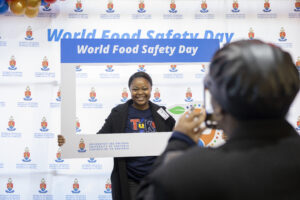
The World Food Safety Day event was co-hosted by the University of Pretoria’s (UP) Department of Residence Affairs and Accommodation (Food Services Division), the DSTI-NRF Centre of Excellence in Food Security (CoE-FS), and the African German Centre for Sustainable and Resilient Food Systems and Applied Agricultural and Food Data Science (UKUDLA). Photo Madelene Cronje/CoE-FS and UKUDLA.
Food safety is a matter of health, dignity, trust and shared responsibility.
This was the central message at the World Food Safety Day event at the University of Pretoria (UP), held on 5 June 2026 under the global theme, “From Burden to Solutions – Safe Food Everywhere”. The event was co-hosted by UP’s Department of Residence Affairs and Accommodation (Food Services Division), the DSTI-NRF Centre of Excellence in Food Security (CoE-FS), and the African German Centre for Sustainable and Resilient Food Systems and Applied Agricultural and Food Data Science (UKUDLA). It brought together food safety practitioners, researchers, municipal officials and institutional food service providers to explore practical approaches to strengthening food safety systems and cultures across South Africa.
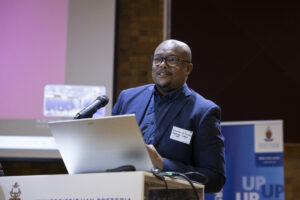
UP’s Director of Residence, Kgomotso Legari, delivered the opening remarks. Photo Madelene Cronje/CoE-FS and UKUDLA.
Professor Lise Korsten, Co-director and Food Safety lead of the CoE-FS, and UKUDLA’s UP-based co-Project Leader, delivered the keynote presentation on “Food Safety Culture in a University Environment”. Drawing on decades of experience in food safety research and practice, she argued that effective food safety cannot be achieved through compliance alone.
“Food safety is a human right,” she said. “It is about dignity. It is about trust.”
According to Professor Korsten, institutions need to move beyond a compliance-based mindset, in which food safety is seen as something done simply because regulations require it. Instead, organisations should foster a culture-based approach, where safe food practices become shared values embedded in everyday behaviour.
“Food safety starts at the top, and it also ends at the top,” she said. “But, ultimately, it is everybody’s responsibility.”
A culture of food safety
Universities present unique food safety challenges. Large student populations, high-volume food preparation, residence dining facilities, food storage practices, supplier management and infrastructure pressures all contribute to a complex food safety environment.
As South Africa’s largest residential university, UP — the co-host of the CoE-FS, and host of UKUDLA’s Graduate Centre — serves thousands of meals daily. In such settings, maintaining safe food is about food preparation and ensuring effective cold chain management, stock control, hygiene practices and continuous monitoring.
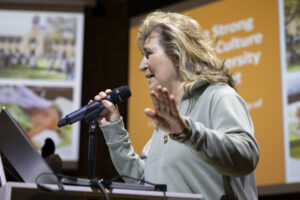
According to Prof Korsten, institutions need to move beyond a compliance-based mindset for food safety, toward fostering a culture-based approach. Photo Madelene Cronje/CoE-FS and UKUDLA.
Professor Korsten noted that students frequently take food back to their rooms, introducing additional food safety risks that require awareness and education rather than simply enforcement.
She emphasised that a strong food safety culture depends on leadership commitment, behavioural change and active participation from everyone involved in the food chain.
“Every meal we serve is a promise of health to our students,” she said.
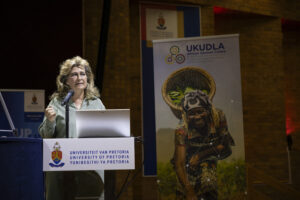
Prof Korsten argued that food safety should be viewed as a systems issue that requires coordinated action across sectors and institutions. Photo Madelene Cronje/CoE-FS and UKUDLA.
The event explored practical ways of embedding food safety into institutional life, including interactive training, regular awareness campaigns, supplier verification processes, improved communication systems and mechanisms that encourage the reporting of risks without fear of blame.
Participants also discussed how students themselves can become active contributors to food safety culture through awareness programmes, training initiatives and feedback mechanisms.
Beyond inspections and compliance
Several speakers highlighted the need to rethink how food safety performance is measured.
While inspections, audits and certification remain important, Professor Korsten argued that they provide only a partial picture. The real test of a food safety system lies in what happens every day in kitchens, dining halls, storage facilities and food preparation spaces.
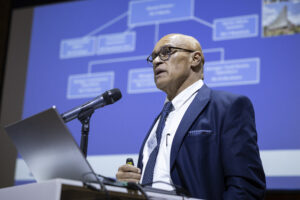
Deputy Director of Residence at UP, Peter Martin, provided an introduction of the Food Services management team, and a history of food services at the university. Photo Madelene Cronje/CoE-FS and UKUDLA.
“How many times have you actually been in the kitchen?” she asked.
A food safety culture is reflected not only in policies and procedures, but in everyday practices, conversations and decision-making.
Participants heard that food safety management systems must become living tools that guide daily operations, rather than static documents that are consulted only during audits.
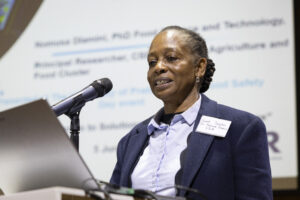
Dr Nomusa Dlamini of the Council for Scientific and Industrial Research presented on “Technology and Digital Solutions in Food Safety Monitoring”. Photo Madelene Cronje/CoE-FS and UKUDLA.
The event also highlighted the importance of Hazard Analysis and Critical Control Point (HACCP) systems, temperature monitoring, record keeping, stock rotation practices such as the “first in, first out” principle, and ongoing verification processes.
Food safety as a systems issue
Discussions throughout the day reinforced the scale of the global food safety challenge.
Globally, an estimated 866 million people become ill from contaminated food each year, while 1.52 million people die from foodborne diseases. Unsafe food is estimated to cost the global economy US$310 billion annually through lost productivity and medical expenses.
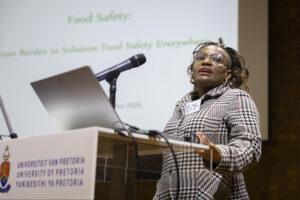
Boitumelo Modikoe from the City of Tshwane presented on the “Critical Role of Municipalities in Food Safety Management”. Photo Madelene Cronje/CoE-FS and UKUDLA.
Closer to home, participants reflected on South Africa’s experiences with major foodborne disease outbreaks, including the 2017–2018 listeriosis outbreak, which claimed more than 200 lives and became the world’s largest recorded listeriosis outbreak.
These events demonstrate the significant human, economic and reputational costs of food safety failures.
Professor Korsten argued that food safety should be viewed as a systems issue that requires coordinated action across sectors and institutions.

The first panel discussion focused on “Crisis Management: Responding to Food Safety Incidents Effectively”. Panellists from left to right: Maki Kupa (Eskom Academy), Nombulelo Hadebe (Entecom), Dr Lindiwe Ncube (University of Mpumalanga (UKUDLA partner)), and Colleen Kgolane Mokoka (Tshwane University of Technology). Photo Madelene Cronje/CoE-FS and UKUDLA.
Food moves across municipal, provincial and national boundaries. Supply chains span regions and countries. Risks can emerge at any point in the system, from production and processing to retail, catering and household consumption.
For this reason, Professor Korsten reiterated the need for stronger regional and national coordination, and has consistently called for an independent food safety framework that can bring together the many actors involved in protecting public health.
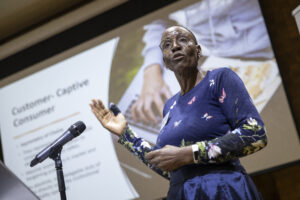
Thezi Mabuza from the National Consumer Commission presented on, “Understanding South Africa’s Food Safety Regulations in Institutional Catering and Legal Implications of Non-Compliance”. Photo Madelene Cronje/CoE-FS and UKUDLA.
Recent initiatives such as the Academy of Science of South Africa’s Food Safety Forum, which Professor Korsten chairs, represent important opportunities for dialogue, knowledge sharing and collaboration between government, industry, academia and civil society.
Shared responsibility
A recurring message throughout the event was that food safety cannot be left to specialists alone.
Whether in universities, schools, households or businesses, safe food depends on everyday actions: washing hands, maintaining hygiene, monitoring temperatures, handling food correctly and reporting risks when they arise.
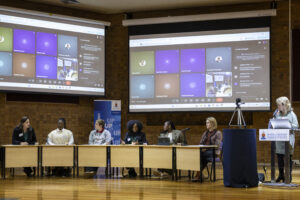
The day closed with a “Future of Food Safety” panel discussion, with input from Prof Korsten’s CoE-FS and UP Food Safety team. From left to right: Dr Loandi Richter, Thabang Msimango, Sheldon Viviers, Mokgadi Molapo, Dr Zethu Mkhwanazi and Alison Levesley. Photo Madelene Cronje/CoE-FS and UKUDLA.
Building a culture of food safety therefore requires leadership from the top, participation from the bottom and a shared commitment across the entire system.
As World Food Safety Day reminded participants, food safety is a collective responsibility that underpins health, trust and human dignity.


related Articles
Public Protector’s report an opportunity to strengthen SA’s food safety system
During a recent Newzroom Afrika interview, Professor Lise Korsten discussed the public protector’s preliminary report into food safety in…
CoE-FS grantee develops new gluten-free food solution
CoE-FS grantee Daddy Kgonothi’s invention makes going gluten-free more affordable. Photo Je’nine May/CoE-FS. Research supported by the DSTI-NRF Centre of…
Inspiring the next generation of scientists in Grabouw
CoE-FS principal investigator and UKUDLA project co-lead A/Prof Clement Nyirenda participated as a panellist in the discussion about science, education…