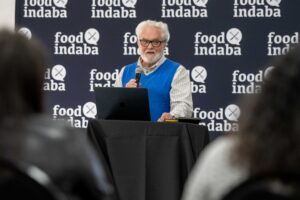
Professor Julian May is the Director of the DSTI-NRF Centre of Excellence in Food Security (CoE-FS), and holds the UNESCO Chair in Science and Education for African Food Systems. Photo Jeffrey Abrahams/CoE-FS.
On Friday, 24 July 2026, the DSTI-NRF Centre of Excellence in Food Security (CoE-FS) and the Food Indaba* hosted a one-day conference, under the theme, “Water, food and the coming crisis: lessons from Day Zero, and pathways to resilience”**. The conference is a fixture of the annual, two-week Food Indaba programme, and has been co-hosted by the CoE-FS for the last four years. Professor Julian May, the Director of the CoE-FS, and holder of the UNESCO Chair in Science and Education for African Food Systems, delivered this year’s synthesis remarks, pulling together the day’s discussions and inputs. The speech he delivered is captured below:
The 2026 Food Indaba began with water as history, memory and living presence. Camissa, the “place of sweet waters”, recalls a mother city shaped by springs, rivers, wetlands and indigenous knowledge, values and spirituality. Water sustained food production, healing, diplomacy with others living in the region, and community life. Colonial intrusions initially sought water, timber, and a place to heal the impact of the poor conditions on the boats. Ironically, the plants of the Western Cape, such as spekboom, sourfig, and dune spinach, contain the very vitamins and nutrients they needed.
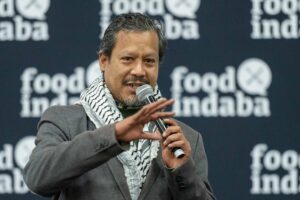
Artist, activist and academic Tauriq Jenkins delivered the context-setting remarks, providing a decolonial history of Cape Town, through the lens of water. Jenkins is the convenor of Save Our Sacred Lands, former chair of the A/XARRA Restorative Justice Forum, and a member of the Goringhaicona Traditional Indigneous Council. Photo Jeffrey Abrahams/CoE-FS.
Subsequent Colonial control of the Liesbeek and surrounding land formed part of a wider dispossession of water, language, history and ecological relationships. South Africa’s contemporary water crisis carries this history forward through racialised settlement patterns, unequal infrastructure and highly concentrated control over natural resources.
The story of the “Vlei Princess” provides a powerful feminist political-economy lens through which to interpret the Indaba. In the legend, the desecration and drowning of a woman produce tears that enter the landscape. The princess represents water, land and the work of sustaining life. Her violation evokes the appropriation of nature and the exploitation of women’s labour. Society continues to depend on her water while forgetting the suffering
from which it flowed.
This is also the story of the food system.
Water is the invisible ingredient in every meal: it grows, processes, cooks and cleans food. When water systems fail, women and communities absorb much of the cost. They find water, stretch household food, care for sick children and compensate for inadequate sanitation and unreliable public services.
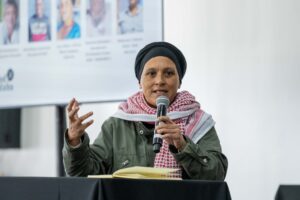
Faeza Meyer is a founding member of the African Water Commons Collective, and plays a leading role in the Western Cape Water Justice Coalition. Meyer was one of the contributors to the panel discussion, “Lessons from Day Zero 1 and lockdown”. Photo Jeffrey Abrahams/CoE-FS.
Women at the Indaba objected to being treated as unpaid volunteers. Their labour, knowledge and time sustain households and communities, yet remain largely absent from budgets, infrastructure plans and conventional measures of economic activity. Women will clean the toilets used daily by the 15 or more people who live in backyard shacks crowded on a single plot supplied with a free basic water of 5,000 litres per month.
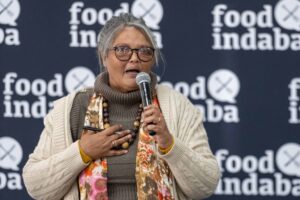
Henriette Abrahams, community organiser, feminist activist and chairperson of Bonteheuwel Development Forum, was one of the contributors to the panel discussion, “Lessons from Day Zero 1 and lockdown”. Photo Jeffrey Abrahams/CoE-FS.
The consequences will intensify as South Africa approaches 2050. SA-TIED foresight work on food security used a projected population of about 79 million to estimate that food security would require roughly 28 million tonnes of maize annually, alongside substantial increases in soybean and poultry production. Under the pathway examined, expanding domestic production largely through irrigation in order to manage reduced or uncertain
rainfall, approximately 400,000 hectares of additional irrigated land would be required. Approximately R3.06 trillion in cumulative investment is required over 30 years, of which R1.83 trillion is for water and irrigation. This includes around R1.62 trillion to rehabilitate and maintain irrigation canals, R55 billion for six to ten additional large dams, R28 billion to repair 100,000 farm dams, R90 billion to clear and control invasive alien vegetation, and R6 billion to strengthen water administration. These estimates represent a particular production pathway rather than a prediction.
Greater rainfed productivity, agroecological production, water reuse, changes in diets and trade could alter the required investment mix. Even under alternative pathways, substantial expenditure on catchments, storage, conveyance, irrigation efficiency, wastewater reuse, energy and maintenance will be unavoidable. The central problem is therefore one of capital allocation, institutional coordination and sustained implementation.
The statement “the state has abandoned us” was made frequently at the Indaba. This referred to all spheres of government, and all components of the state. Communities experience abandonment through leaking pipes, recurring diarrhoeal disease, inadequate free basic water, overcrowded plots and promises followed by temporary repairs. Apartheid remains visible in the water infrastructure: where it was built, whose systems are maintained and whose shortages have become normalised. Fragmented responsibilities compound the problem. No institution appears fully accountable for protecting catchments, clearing invasive vegetation, maintaining canals, reducing municipal losses and securing household access. The influential Water User’s Associations, and who controls these, was not discussed although local control of resources may contribute to inequities.
The state itself is not monolithic. Capable administrators may be undermined by political interference, divided mandates and the diversion of infrastructure resources. Yet the scale and public character of the required investment confirm that community self-provision and privatisation cannot provide an equitable solution. Private investment may contribute finance and expertise, although allocation driven by profitability will favour those able to pay. Large agricultural, beverage, mining and data-processing interests already have greater influence over water than the households whose survival depends upon it.
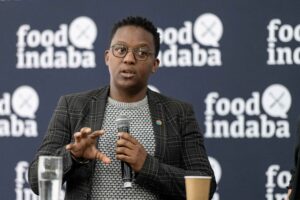
Public interest strategist and movement builder Nkosikhona Swartbooi was one of the contributors to the panel discussion, “Lessons from Day Zero 1 and lockdown”. He is the coordinator of the Movement for Collective Action and Racial Equity (Movement4CARE). Photo Jeffrey Abrahams/CoE-FS.
Participants argued that civil society’s task is to turn episodic solidarity into durable organisation. Communities can map water access, document infrastructure failures, track repair commitments, identify households facing hunger and disease, scrutinise budgets and demand disclosure of large commercial water allocations. Campaigns can connect water, food, housing, sanitation, electricity and health as parts of a shared struggle for a decent
life. Litigation, budget advocacy, public hearings, consumer action and targeted boycotts can complement community organisation. These actions should strengthen public accountability while resisting the transfer of state responsibilities onto unpaid community labour.
Storytelling, film and witnessing are also forms of political infrastructure. What is undocumented can be denied or dismissed as an isolated incident. Stories connect household suffering to policy choices, reveal patterns of inequality and help communities recognise their collective power.
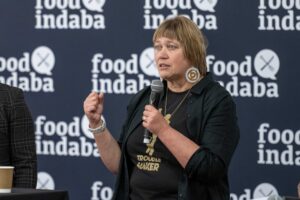
Documentary filmmaker Miki Redelinghuys was one of the contributors to the panel discussion, “Lessons from Day Zero 1 and lockdown”. She is co-director of the Climate Story Lab South Africa, and co-directed the documentary, ‘Mother City‘. Photo Jeffrey Abrahams/CoE-FS.
Academics can contribute by combining community knowledge with hydrology, nutrition, public health, infrastructure planning, municipal finance and political economy. Participatory mapping, citizen monitoring, oral history, learning journeys and action research can establish credible evidence while democratising its production. Researchers should also test proposed solutions, identify unintended consequences, expose the distribution of costs and benefits, and preserve institutional memory of what communities have achieved. Research needs to move from the lab to be closer to communities. Researchers should engage with the state, and be willing to speak ‘truth to power’ uncompromised by conflicts of interest.
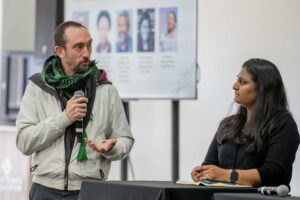
Dr Florian Kroll, Project Lead at the CoE-FS, and Disha Govender, former head of Ndifuna Ukwazi Law Centre, participated in the panel discussion, “Mitigation, governance and policy”. Photo Jeffrey Abrahams/CoE-FS.
A call from the conference to “fetch our own water” is therefore a demand to reclaim history, agency and democratic control. The Vlei Princess’s tears make visible the submerged costs of the food and water systems: women’s unpaid labour, ecological damage and the abandonment of communities. South Africa’s response must join infrastructure investment to institutional reform, ecological repair and public participation. As the Indaba reflected, every future begins upstream, but it is ultimately shaped by who controls the water, whose labour keeps it flowing and whose lives are valued when it runs out.
*The CoE-FS is a co-sponsor of the annual Food Indaba programme, and the Food Indaba is supported by the UNESCO Chair in Science and Education for African Food Systems, and the African German Centre for Sustainable and Resilient Food Systems and Applied Agricultural and Food Data Science (UKUDLA).


related Articles
US war on Iran could deepen Africa’s food insecurity and instability
Prof Julian May is the Director of the DSTI-NRF Centre of Excellence in Food Security (CoE-FS), which is hosted by…
Waste as a resource, not a problem: insights from the Breede Valley
For her master’s research, Nolutando Didiza looked at two case studies in the Breede River Municipality: a bioenergy plant that…
Advancing food security through global partnerships: CoE-FS, UKUDLA hosts German Federal Minister...
Minister Alois Rainer, head of Germany’s Federal Ministry of Agriculture, Food and Regional Identity, undertook a high-level courtesy and working…