
Read the article on Day 1 of the “Symposium on Food Prices and Affordability in South Africa” here. Photo Madelene Cronje.
Day two of the “Symposium on Food Prices and Affordability in South Africa” began with an international and conceptual framing of food affordability by Professor Jane Battersby, a member of the International Panel of Experts on Sustainable Food Systems (IPES-Food).
Drawing on the Panel’s work, Professor Battersby noted that the current global focus on affordability presents both an opportunity and a risk: while the cost-of-living crisis has created space for more progressive policy conversations, it has also enabled reactionary narratives that shift blame rather than address structural causes.
Central to her argument was a critique of dominant “affordability narratives”, particularly what she described as the “false savings trap”. Efforts to make food cheaper, she argued, often lead to the proliferation of ultra-processed, nutrient-poor foods, rather than improving access to adequate, healthy diets.
“Making food cheap is not the same as making food properly affordable or adequate,” said Battersby, who is based at the University of Cape Town (UCT).
The IPES-Food expert also challenged the assumption that raising incomes alone would resolve affordability, warning that increased purchasing power within an unequal food system can, instead, expand access to unhealthy food options. She further argued that food affordability must be understood as part of the right to food, with corresponding obligations on the state.
Food reserves and buffer stocks
In her presentation on food reserves and buffer stocks, Dr Noncedo Vutulu of the Nelson Mandela School of Public Governance at UCT, highlighted the importance of local governance in shaping effective interventions, and the potential of decentralised models. She clarified the difference between food reserves and buffer stocks: the former, broad storage systems for emergency or strategic use; the latter, more targeted instruments used to stabilise prices through buying and releasing stock as prices drop or increase.
“All buffer stocks are food reserves, but not all food reserves function as buffer stocks,” said Dr Vutulu.
She traced the historical role of buffer stocks in stabilising prices and strengthening resilience, noting their decline in many contexts following widespread economic liberalisation since the 1980s. Countries such as India and Indonesia continue to use large-scale buffer stocks for price stabilisation, while systems in Africa and Latin America are generally more limited and focused on emergency response needs.

Participants at the Symposium on Food Prices and Affordability in South Africa. Photo Madelene Cronje/CoE-FS.
Vutulu noted that international trade rules governed by the World Trade Organization do allow for buffer stocks, but also impose limits on them. This tension between domestic policy priorities and international rules emerged as a key consideration for South Africa.
For South Africa, Vutulu emphasised that buffer stocks should be understood as one component of broader food security architecture. A combination of interventions includes strategic reserves, support for smallholder farmers, regulation of local food environments, and complementary subsidies for transport and electricity.
Informal sector
A critical component of food access in low-income communities is the informal sector. Informal markets, spaza shops, and small traders were discussed not as peripheral, but as central to affordability — particularly where formal retail is inaccessible or unaffordable.
The DSTI-NRF Centre of Excellence in Food Security’s (CoE-FS) Professor Marc Wegerif illustrated how street vendors are selling fruits and vegetables at substantially lower prices than formal sector businesses. Drawing on a recent CoE-FS study, during two years, tomatoes from formal retailers were found to be R9.63 (53%) more expensive per kilogram than those from street vendors.
Professor Wegerif also noted the “rocket and feather” effect, demonstrating how formal retailers were slow to reduce prices when wholesale prices dropped, while street vendors adjusted much more quickly. He referred to CoE-FS maize data, showing that independent retailers and spaza shops often sell the same maize meal at lower prices than supermarkets.
Wegerif, a CoE-FS principal investigator, emphasised that for many households, the informal sector is not only a cheaper alternative, but the most immediate and reliable point of access to food. Its importance lies in proximity, flexibility, and the ability to sell in smaller quantities, allowing households to navigate constrained and irregular incomes. At the same time, these markets often operate within tight margins, shaped by the same rising input costs, fuel prices, and supply constraints affecting the formal sector.

Drawing on a recent CoE-FS study, during two years, Prof Wegerif illustrated that tomatoes from formal retailers were more expensive per kilogram than those from street vendors. Photo Madelene Cronje/CoE-FS.
He argued that the informal sector must be understood within the broader food system as one contributor to food affordability alongside other options, rather than treated as separate or secondary.
“The food system includes all of these actors. We can’t analyse prices in one part of the system without understanding how the rest of the system is functioning.”
Engaging with this, participants highlighted the governance challenges within the informal sector, including uneven pricing, limited oversight, and vulnerability to political pressure. However, these challenges were not framed as reasons to marginalise informal actors, but as areas requiring more thoughtful policy engagement.

Oscar Sithole, a PhD candidate at the University of Pretoria, and a CoE-FS grantee, under the supervision of Prof Wegerif. Photo Madelene Cronje/CoE-FS.
Concluding his session, Wegerif suggested that planning must reserve a minimum amount of space for food markets per 1 000 homes, an approach used in China.
“Everyone should live within walking distance of a food market,” he said.
Learning from Brazil
Thomé Luiz Freire Guth of the Companhia Nacional de Abastecimento in Brazil offered a practical example of how food affordability can be addressed through coordinated public systems.
The Brazilian model was presented not as a single intervention, but as a layered architecture, combining price support, public procurement, strategic food reserves, and social protection. At its core is an active role for the state in stabilising food systems, supporting producers, and ensuring access to affordable food for vulnerable populations.
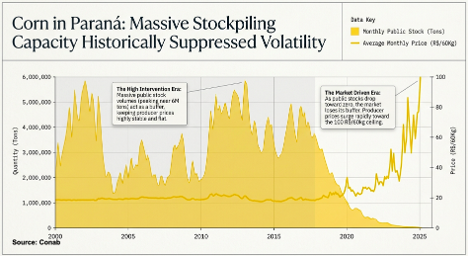
Freire Guth showed graphs of food price fluctuations alongside the size of food reserves, which clearly illustrated far more stable food prices when the buffer stocks were fully functioning, and much more food price instability when the government allowed the food reserves to be depleted and inactive.
Emphasis was placed on how public procurement programmes link smallholder farmers directly to state-supported food schemes, including school-feeding programmes. This creates a dual effect: supporting livelihoods on the production side, while improving access to food on the consumption side.
Freire Guth also highlighted the role of public institutions in managing food stocks and responding to price volatility, reinforcing earlier discussions on buffer stocks, but situating them within a broader, more integrated system.
Influence through economic policy
Merle Schulken from the University of Massachusetts Amherst examined the role of taxes, duties, incentives, and broader fiscal tools in shaping food affordability, shifting attention to how governments can actively influence food systems through economic policy. The emphasis was on identifying intervention points across the value chain, from production and inputs to processing, distribution, and retail.
Key considerations included how taxes and duties can both raise and reduce food prices, depending on how they are structured. While some fiscal measures may unintentionally increase costs for consumers, others — such as targeted subsidies or incentives — can be used to support the production and distribution of more affordable, nutritious foods.

Participants at the Symposium on Food Prices and Affordability in South Africa. Photo Madelene Cronje/CoE-FS.
The discussion also returned to the role of incentives in shaping market behaviour. Participants explored how policy can be used to encourage investment in local production, agro-processing, and shorter supply chains, thereby reducing reliance on imported goods and mitigating exposure to global price shocks.
At the same time, the limits of purely economic tools were acknowledged: fiscal interventions, while important, must be aligned with broader regulatory and social policies to ensure that they do not reinforce existing inequalities or market concentration.
Social protection
Kelle Howson from the Institute for Economic Justice argued that while social grants remain critical, their impact has been weakened by declining adequacy relative to rising food costs, alongside significant coverage gaps. The Social Relief from Distress grant remains temporary and narrowly targeted, with evidence suggesting that up to 90% of those excluded are, in fact, eligible, pointing to systemic exclusion.
More broadly, 66.7% of South Africans live below the upper-bound poverty line, and 17.6% below the food poverty line, underscoring the scale of income poverty driving food insecurity.
In this context, Howson called for a shift toward a rights-based approach, centred on a universal basic income as a more effective and inclusive mechanism for addressing income poverty and food insecurity.
“Ensuring that people have sufficient income to purchase basic nutritious food is one of the most immediate ways the state can intervene in food insecurity,” she said.

Participants at the Symposium on Food Prices and Affordability in South Africa. Photo Madelene Cronje/CoE-FS.
Howson explained how direct income support programmes can significantly improve food security and nutrition. In Namibia, a basic income pilot reduced daily food shortages from 30% to 12% of households within seven months, while households never experiencing shortages increased from 20% to 60%, alongside improvements in child nutrition. In Kenya, long-run pilots increased dietary diversity and protein consumption, with protein intake rising by up to 25%.
For South Africa, the proposal is for a universal, adequate, and unconditional basic income for working-age adults, pegged to at least the food poverty line and designed to eliminate exclusion while simplifying delivery. Positioned alongside food system reform, it was presented as one of the most direct and achievable tools to close the food affordability gap.
Outcomes and commitments
Closing the second and final day, participants identified and refined interventions to improve food affordability, drawing directly on the evidence and debates from across the symposium, shifting from broad policy ideas to more grounded, system-level interventions
Strengthening food price monitoring systems to generate more granular, real-time data across the value chain was identified as a crucial intervention area. Improved transparency is critical, particularly in understanding how prices are set in the formal sector, and how pricing operates within informal markets.
Interventions to stabilise prices were also prioritised, including the use of buffer stocks, food reserves, and targeted price regulation measures. These should form part of a broader public role in shaping food systems and managing volatility.

Participants at the Symposium on Food Prices and Affordability in South Africa. Photo Madelene Cronje/CoE-FS.
Participants also underscored that affordability cannot be addressed without increasing household purchasing power, and proposals included raising social grants to align with the cost of nutritious diets, increasing the minimum wage, and advancing a universal basic income grant as part of a strengthened social protection framework.
Discussions further emphasised the importance of supporting local and informal food systems. This includes investment in smallholder farmers, shorter supply chains, and agro-processing, alongside more deliberate provision for informal traders through infrastructure, spatial planning, and market access. Cross-cutting these interventions was a strong emphasis on governance. Participants identified the need for improved coordination across state institutions, stronger accountability mechanisms, and more active regulation of corporate concentration within the food system.
Rather than concluding the conversation, the symposium marked the beginning of a more coordinated phase of engagement. These outcomes provide a foundation for ongoing research, policy development, and collaboration toward a more equitable and affordable food system in South Africa.
Read the article on Day 1 of the “Symposium on Food Prices and Affordability in South Africa” here.


related Articles
“Umhlabathi impilo” — PhD candidate’s research highlights farmers’ resilience, ingenuity
Njabulo Mncwabe’s research has been a journey into understanding and supporting local food systems in Umbumbulu, KZN, highlighting the resilience…
US war on Iran could deepen Africa’s food insecurity and instability
Prof Julian May is the Director of the DSTI-NRF Centre of Excellence in Food Security (CoE-FS), which is hosted by…
Advancing a food affordability policy agenda in South Africa
A/Prof Marc Wegerif, CoE-FS principal investigator, served as facilitator for the symposium. Photo Madelene Cronje/CoE-FS. Rising food prices, deepening food…